
Mutually exclusive
Editor's note: Phill Agnew is director, product marketing, at Brandwatch, a London-based social intelligence company.
It’s a familiar picture for many working in a large corporation. They’re in the boardroom of a multibillion-dollar company, their CFO is presenting the numbers and it’s not great. They’d been in line for a big bonus but sales are just below the goal to meet the quarterly target.
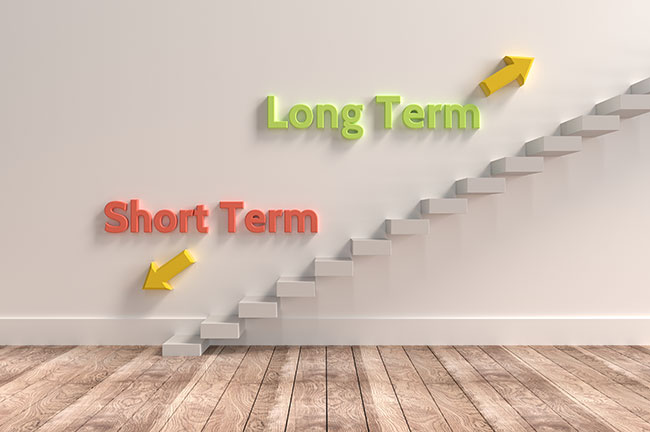
It looks like they’ll be waving goodbye to their hopes of a bonus. Unless they do something radical in the short term to boost sales, like a quick price promotion or two-for-one deal. Sure, it might not yield long-term benefits to the business but it would definitely help in the moment and get them closer to meeting the quarterly target.
While this way of thinking might seem shortsighted, it’s commonplace for organizations that are under ever-increasing pressure to meet ambitious targets and show profitability.
A recent study by McKinsey found that two-thirds of executives believe short-term pressures have increased1 and as a result we’ve become more focused on short-term wins. A clear example of this is the average holding times for shares. Back in the 1960s, shareholders would typically keep hold of shares for one year; today, it’s less than six months.2
In fact, 80% of CFOs3 at the world’s largest companies would willingly sacrifice long-term values for tactics that hit this quarter’s goals. This tactic, according to Gareth Price’s thesis Thinklong,4 places huge pressure on marketing, which has inevitably led to CMOs having the shortest job expectancy in the boardroom, averaging at just three-and-a-half years.
Doesn’t bode well for brand-building
The problem with this focus on short-term thinking is it doesn’t bode well for brand-building. The types of tactics it encourages – sales promotions, short-term comms and cuts to marketing spend – all damage brands in the long term.
Instead, organizations need to invest in long-term thinking around brand-building and realize short-term goal-hitting doesn’t supersede long-term growth.
In his book How Brands Grow, Bryon Sharp neatly details the problem with some short-term approaches. He explains why organizations should be cautious about using price promotions to drive sales. His analysis shows that sales promotions often do bring in a short-term spike in sales. This happens because the promotions bring in non-frequent buyers. Certain buyers switch between brands and tend to buy whatever is cheapest on the market, resulting in a short-term gain.
However, this means when the promotion ends, sales immediately return to their regular level. These promotions mean a smaller margin, so in order for the brand to gain profitability, it needs to secure long-term future sales with these tactics, but that’s not what they deliver.
Seeing as sales promptly return to normal after the price promotion ends, brands often generate no lasting value from these short-term activities. A much smarter approach is to create long-term plans that actually add compounding value.
Acting on the value
Part of the problem is the huge wealth of data we get from market research agencies and market research technology and our approach to finding and acting on the value of this rich data.
Gone are the days where we’d get a monthly or quarterly view on brand recall. Now we can see day by day, or even hour by hour, customer feedback from online panels or distributed surveys. There’s still traditional qualitative research, which needs to be built on a foundation of hard, diverse data and analysis, but now there’s also social media data and survey results – which should complement one another.
This never-ending flow of data should benefit us. It should reveal flaws in our product, or opportunities to go after. But we’re human and that’s not how we naturally operate – this influx of data, if unmanaged, can render research ineffective, falling miles short of its transformational promise.
Robert Metcalfe, an assistant professor at Boston University, wrote a fascinating paper on the paradox of constant data. His paper looked at the decisions that stock traders made based on the amount of data they were given. If we’re thinking of traditional market research in this scenario, we could safely assume that the more data these traders had, the better their decision-making would be. But that wasn’t the case. When traders were given less information, they were more likely to invest in riskier but higher-profit stocks. Meanwhile, the data-fuelled traders were more risk-averse and quick to sell stocks as soon as they started to drop.
In all, the traders with less data actually had a much higher profit of 53%. This isn’t as simple as being about the amount of data but rather what we touched on earlier, that how data is gathered and analyzed makes all the difference.
Same value propositions
Back in 2008, comparison sites all looked pretty similar. Go Compare, Moneysupermarket, Confused and Comparethemarket all focused on functional benefits, like how much they saved the average consumer. This made a lot of sense at the time; after all, these are important benefits. But everyone was claiming the same value propositions and so they didn’t generate any long-term value of differentiation.
In 2009, Comparethemarket decided to take a different long-term approach. Rather than communicate rational benefits, it followed a more emotional route. It created Aleksandr Orlov, the meerkat who owned Comparethemeerkat.
In the ads, Aleksandr complained about how the wrong visitors came to the site, expecting to find car insurance. Gone were the rational benefits and the stats on how much money you could save – but the results were considerably positive.
After this move, Comparethemarket rose from the fourth-ranked site to the first in terms of consideration and spontaneous awareness. Quote volumes went up by 83 percent and the company achieved its 12-month objectives in nine weeks, according to Richard Shotton’s analysis.5
Ten years on, Comparethemarket still uses the same campaign and still sees positive results. It’s leading the market, it stands out compared to small competitors and its campaign even inspired other competitors to follow similar themes (see Go Compare’s opera singer). Sticking to a long-term strategy pays off.
Circumvent this problem
Marketers and market researchers should broaden their focus and start to set longer-term goals for their work in order to circumvent this problem. Specifically, they should start lobbying for practices that encourage long-term investment and remove measures that don’t relate to long-term value creation. For measurement, brand marketers need to stop conducting market analysis on their brand on a short-term, one-off basis.
Take this example. If we look at conversations around a brand that was the subject of some unflattering news in the last seven days, the picture might be bleak. Negative conversation could be on the rise, growing by double-digit percentages week on week. Based on this seven-day analysis, there could be some knee-jerk reactions. But if we broaden the time period we look at, it might be a different picture entirely. In fact, we might see that negative conversation about the brand has dropped dramatically compared to previous years.
A short-term, daily focus would miss this insight entirely. It might lead a marketer or analyst to assume that the brand perception is negative and that short-term campaigns are needed. But taking a step back and analyzing your brand on a wider time scale reverses the picture and provides the context needed.
Advice is clear
When it comes to effective market research, the advice is clear: monitor long-term trends before short-term shifts; use historical data to add context to daily or hourly insights; focus less on instant, one-off surveys and invest in longer-term variations; and build up a wealth of historical data to compare with ongoing data.
There aren’t specific metrics you should monitor in every situation. That’s better set by those who know the product and brand. But this advice should help steer you away from metrics that will warp your decision-making.
A good acid test to apply to your own business is to look at the last survey, focus group or other type of research project you conducted. Did it build on historical results? Did it last longer than a month? Did it check to see how consumer views and opinions have changed over time? If it only analyzed a snapshot of how your consumers felt then it will probably cause more harm than good.
Context is vital
When it comes to building a brand, long-term approaches will always trump short-term thinking. And when it comes to measuring your success, context is vital. A long-term view of data, preferably by the year, is key to seeing if trends are really developing. And a contextual look at competitors is useful for setting benchmarks.
What’s best, then, is to take a step back and check that the vantage point that you’re looking at the data from gives you the most far-reaching and clearest view.
References
1 “Measuring the Economic Impact of Short-Termism,” McKinsey Global Institute, February 2017.
2 NYSE Factbook via Forbes (“Stock market becomes short attention span theater of trading,” January 21, 2011).
3 “Value Destruction and Financial Reporting Decisions,” by John R. Graham, Campbell R. Harvey and Shiva Rajgopal.
4 Thinklong by Gareth Price via podcast Sweathead with Mark Pollard.
5 The Choice Factory by Richard Shotton.