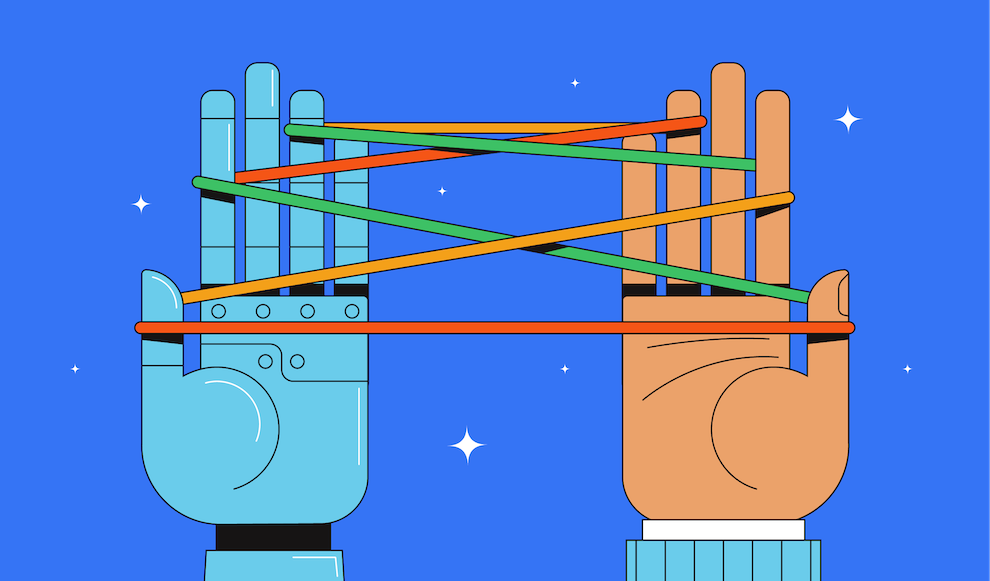
Running to stand still
Editor's note: Eric Karofsky is an expert in AI adoption, with a focus on designing user experiences that make AI understandable, usable and trusted. The founder of VectorHX, a human experience agency, he brings more than 20 years of experience in CX, UX and employee experience strategy, working with major brands like Fidelity, The Hartford, Michelin and Reebok. Find Eric on LinkedIn.
AI can now analyze a 90-minute focus group almost instantly. It will surface themes, flag sentiment shifts, count how many times a word appeared and generate a tidy summary you can drop straight into a slide deck.
Here's the problem: none of that is an insight.
It's analysis. And analysis is not the same thing as understanding. The gap between the two – between what AI produces and what organizations actually need – is a design and interpretation problem. And it's where the work that actually matters still gets done by humans.
I've watched this play out across different organizations. A research team runs a study using AI-assisted analysis. The platform produces a clean summary: customers value convenience, price sensitivity is high in the 35-54 demographic and there's growing interest in sustainability among younger cohorts.
The stakeholders nod. The slide gets built. Six months later, the product team makes a decision that contradicts what customers actually meant – because no one ever asked why convenience mattered or what trade-offs people were actually making between price and quality or whether "sustainability" meant the product itself or the company's broader practices.
The AI got the what. Nobody got the so-what.
This is the pattern I keep seeing – and it's not a failure of the tools. It's a failure of the process around them.
The front end is where it starts
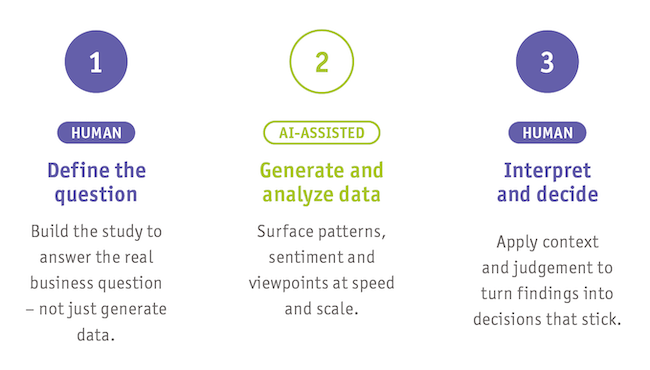
Strong research design has to be in place before AI enters the picture – not bolted on afterward.
Research design means building the study so that it can actually answer the business question – not just generate data. It means choosing methods intentionally, asking questions that surface real behavior rather than stated preference and sequencing the work so that early findings can sharpen later questions. None of that is automated. A well-designed study with mediocre AI analysis will almost always outperform a poorly designed study with great AI tools.
Too many teams are applying AI at the back end of a process that was never set up to produce useful findings in the first place. The AI runs fast. It just runs fast in the wrong direction.
And at the other end, interpretation means bringing human judgment to bear on what the findings actually mean for this organization, at this moment. That requires industry knowledge, business acumen and an honest understanding of organizational dynamics – who will act on these findings, what they need to hear versus what they want to hear and how to frame the recommendation so it lands.
What AI is genuinely good at
Let's be clear about what AI does well in research, because dismissing it is as wrong as over-crediting it.
AI excels at speed and scale. It can process thousands of open-ended survey responses in the time it used to take a junior analyst to get through a few. It can identify patterns across qualitative data that would take a human weeks to find. It reduces transcription errors, eliminates a lot of low-value manual work and can run semantic analysis at a consistency that humans simply can't match across a long project.
These are real capabilities. They're changing what's operationally possible.
But here's what I've noticed in client work: teams that hand AI outputs directly to stakeholders – without a translation layer built on real human judgment – routinely produce insights that are accurate on the surface and useless in practice.
In 2025, Deloitte delivered separate AI-assisted reports to government clients in Australia and Canada that were found to contain fabricated citations and references to nonexistent studies – reports that looked authoritative but couldn't be verified.1
What AI can't do
AI routinely misses context. It can't determine which theme is strategically significant for your business as opposed to simply frequent in your data. It doesn't know that your company is about to reposition its pricing structure, that your largest competitor just entered a new segment or that one of the "minor" themes it flagged actually maps onto a pain point your leadership team has been arguing about for three quarters.
Context lives with people. It doesn't live in the data.
AI can surface a range of viewpoints – and it's genuinely useful for that. It can represent the spread of sentiment across a dataset, show where opinion clusters form and flag where disagreement is sharpest. But surfacing viewpoints and analyzing them are different things. Deciding which perspectives matter, which tensions are strategically meaningful and what the organization should actually do about any of it – that's human work. The analysis cannot be delegated to the tool that produced the data.
This is where I'd push back on the narrative that AI is shrinking the research function. What I see is more nuanced: AI is eliminating certain tasks while raising the stakes on others.
The researchers who are struggling right now tend to have built their careers around execution – data collection, coding, transcription, summary writing. Those tasks are being automated and the displacement is real.
The researchers who are thriving are the ones who were always doing the harder work: designing studies that get at real behavior, synthesizing across methods, translating findings into decisions that stick. AI doesn't threaten those people. It actually amplifies their impact, because they spend less time on the rote work and more time on the judgment.
The shift is uncomfortable because it requires research teams to develop – or honestly assess whether they have – a different set of capabilities. Can your team take an AI-generated theme cluster and turn it into a strategic recommendation? Can they distinguish between a finding that's interesting and a finding that's actionable? Can they sit across from a skeptical CMO and defend a qualitative insight against a dashboard full of conflicting quantitative data?
These are human skills. And they're not evenly distributed.
What this means for how teams are structured
One implication I see playing out: Research departments are reconsidering what they hire for and what they outsource.
The operational tasks – fielding, transcription, initial coding, data cleaning – are increasingly handled by tools or offshore support, with AI accelerating the work. But the interpretation layer is being held more tightly by senior people and in some organizations it's being elevated rather than reduced.
The smart insight teams I see are also building stronger feedback loops between research and decision-making. That means embedding researchers earlier in product and marketing cycles, not just bringing them in to validate decisions already made. It means treating the insight function as a strategic capability, not a cost center that produces reports.
That repositioning is only possible when research teams can demonstrate judgment – not just speed and not just volume.
The question to ask yourself
If your team is adopting AI tools – and you should be – spend some time on this question: Where exactly does the human judgment live in your process?
Not in theory. Not on an org chart. In practice.
Who is responsible for deciding which business question the study is actually designed to answer? Who interprets the AI-generated analysis against the strategic context of your organization? Who translates findings into a recommendation and owns that recommendation in the room?
If those roles are clear and those people are strong, AI will make your team faster and more capable. If those roles are fuzzy or those skills are thin, AI will mostly help you produce better-looking outputs that lead to the same poor decisions.
The technology isn't the bottleneck. The human layer is. That's been true for a long time in research and nothing about AI changes it. If anything, the gap between teams that have built real interpretive capability and teams that haven't is about to become a lot more visible.
References
1 “Deloitte allegedly cited AI-generated research in a million-dollar report for a Canadian provincial government,” Fortune, November 25, 2025.
“Why Deloitte's $440,000 AI report is a warning to every organisation using artificial intelligence,” CJPI, October 11, 2025.