
Editor’s note: Joris de Bruyne is partner at Belgium-based behavioral insights company EyeSee. This is an edited version of a post that originally appeared under the title, “Exciting times for the market research industry ahead.”
Market research is transforming and re-inventing itself, yielding opportunities for new research tools, methods and technologies. Digging into the changes, EyeSee’s Partner Joris de Bruyne shared his own expectations:
“2019 is shaping up to be an exciting year for market research as more and more paradigm shifts become obvious. While our team continues to grow, I am taking the time to re-collect, reflect on and make sense of trends, compelling remarks and key takeaways from the 2018 conference as well as various analytical texts promising a glimpse into the future. Following are three observations which [will] affect, if not completely change, how we do business.”
1. Insights grow on tech giants.
“Currently, we are a data-driven business. However, we should aim to be an insight-driven business,” said Didier Truchot, Ipsos CEO, founder and co-president.
In other words, many businesses use data to support their decisions instead of drive their actions. Why is this so? After all, data is really only valuable if we can translate it into actionable insights. First, we need to figure out what we want from data and define its value, which implies providing a more complex analysis of the context, need, vision and outcome of data, and offering a helpful framework for turning that data into business success stories. And we happen to be witness to the changes that major market research companies are going through:
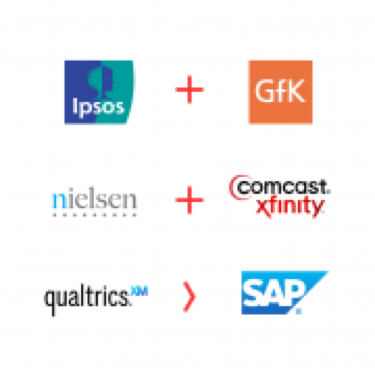
- Ipsos bought four divisions of GfK,
effectively incorporating GfK’s research-based services, customer and employee satisfaction and loyalty index, innovation testing, user experience research, consultancy and more.
- Nielsen and Comcast announced the expansion of their relationship to include digital measurement of Comcast’s Xfinity’s Stream app and Web portal. Furthermore, Nielsen itself might be facing a possible acquisition.
- SAP acquired Qualtrics, which competes with SurveyMonkey in the survey software market, just before the IPO of $8 billion. SAP has been counting on new cloud products for growth as the move away from traditional desktop software has taken its business from the core enterprise resource planning business.
These are just some of the most prominent cases reinforcing the notion that the insights world grows more integrated into the work of software giants and Silicon Valley unicorns, thus affecting the transformation of, and generating both competition and opportunity for, dominating players.
2. Combining approaches set to face the challenge of omnichannel promotion.
Former Tesco e-commerce pioneer Grant Wither remarked that the company developed its online business initially as separate. Today the tendency is to provide seamless and frictionless integration in multi-channels with loyalty programs as the key and focal point. Innovations like voice controls offer the continuous conversation and shopping experience and overcome text-based limitations, according to Tesco Tech Product and Data Platforms Director, Sean O’Neill.
Retailers are not the only ones getting creative with data; the big brands are on board as well. Upma Vermani, Adidas senior manager of consumer insights, analytics and operations, explained how the brand builds meaningful and engaging relationships which are focused around the identified causes people actually care about. We are in the era of the “phygital consumer” who expects the same experience from both brick and mortar and online stores. Combining approaches in physical and digital spaces – in order to understand needs, triggers, barriers, occasions and the path to purchase – is a must.
Nick Miles, head of Asia-Pacific at IGD, recently highlighted the high rate of smartphone penetration that was made possible by new retail partnerships, unique eco-systems and big circumstances. Asia’s effective embrace of phygital marketing makes it the future leader of e-commerce based on scale, pace, innovation and drive – the rest of the world should take notes.
Furthermore, artificial intelligence (AI) supercharges the possibilities for new types of omnichannel insights, which is the focus of the excellent book by Unilever Executive Vice President Stan Sthanunathan titled, AI for Marketing & Product Innovation. The book offers creatives and marketing professionals a non-tech guide to AI and machine learning – twin technologies that stand armed and ready to revolutionize the way we sell. The key challenge is to use augmented intelligence to become information rich in order to take the massive leap in evolution of consumer connections.
MIT Professor Pattie Maes shared that extended intelligence (e.g., sensors) opens a completely new set of opportunities to support individuals and research.
3. Agility and scale become new standards for market research.
Many of the tools in use today having been introduced to market research decades ago and the industry could hardly be described as the most fast-paced, agile or innovative. However, things are changing, and pressure is coming from the demands consumers place on marketers. The average consumer expects a seamless shopping experience with elements of engagement and discovery. Tom Pickford, P&G director of e-business, observed that the way to win the consumer has become more sophisticated; today it is all about personalization, efficiency and brand transparency which in return means a level of automation.
Philips’ Anne-Sterre Mees stressed how important it is to reduce the overall time spent pushing products or ads on the market, while Henry Nicholson, head of shopper insights for northern Europe at Mondelez, proposed the test and learn approach to achieve needed agility. A good example of this is Twitter’s Jake Steadman who performs speedy mobile survey studies with under one thousand users and less than one million tweets.
The majority of research suppliers who plan to remain relevant are up for re-brush and re-organization. The question they need to ask themselves is: Are we able to scale studies globally, with high reliability and in time frames that match the marketplace?