

Public opinion study reveals Americans are uncertain about major issues
Editor’s note: Elissa Moses is CEO of BrainGroup Global, with 50 years of experience in corporate brand insights, research design innovation and behavioral science. She is the author of “The $100 Billion Allowance.” Moses has a bachelor’s degree in human behavior from the University of Chicago, a master’s degree in technology management from Columbia University and a certificate in behavioral science from Yale University. Find Moses on LinkedIn.
A recent national public opinion study conducted by BrainGroup Global and iCode reveals that the public is uncertain about almost every major issue facing America today, with some very specific concerns. Adults are in flux about our nation’s children, concern over their mental health as a result of social media and the less than human, AI-driven experience we fear our kids will have in future classrooms.
Why ambivalence matters
Simply stated, when we are uncertain of our beliefs, it leaves us open to changing our minds. In this age of propaganda, bots and “fake truths,” it is somewhat unwise to take survey answers at face value or to make reliable predictions for consumers or voters simply on “yes/no” or scaled answers.
This is because there are several important psychological dynamics at play when respondents answer surveys.
- Respondents lean one way but have internal misgivings.
- Respondents lean one way but worry that their inner feelings are socially unacceptable or do not reflect their desired image.
- Respondents just do not care about being truthful and want to get through the survey as quickly as possible.
By using reaction time metrics as an overlay to survey response, researchers benefit from an immediate set of additional measures revealing how firm response levels are to each question. This enables analysis across population segments and also comparatively within groups, item by item. For every scaled answer, there are now at least two metrics. One is the conscious designation – for instance yes, no or maybe – and the other is a response time indicator establishing whether or not the answer is provided strongly with conviction or weakly with uncertainty.
In this study, slow response patterns suggest that Americans are vulnerable to changing their minds in both directions.
For instance, there is wide ambivalence over major public policies and issues such as whether or not “America was right to attack Iran,” “America should acquire other countries,” “America is letting Ukraine down” or “being anti-Israel is being antisemitic.” The combined levels of uncertainty for each question, 64%, 76%, 76% and 87%, respectively, indicate that two-thirds to three-fourths (or more) of America are just not sure what is right. This also means that the country’s majority is predisposed to being persuaded to another position. With such uncertainty on both sides of major issues, the climate is ripe to change opinions and potentially have a major impact on public sentiment and voting behavior for the 2026 elections.
The public shares AI concerns
Observationally, it seems as if every conference agenda in the market research industry spotlights the pros and cons of AI and addresses potential dehumanization threats due to advances in AI technology. But it appears this is not an industry dilemma. The nation at large is fraught with confusion and concern over AI.
The ambivalence centers mostly on whether or not AI can improve education for our children or potentially make it worse.
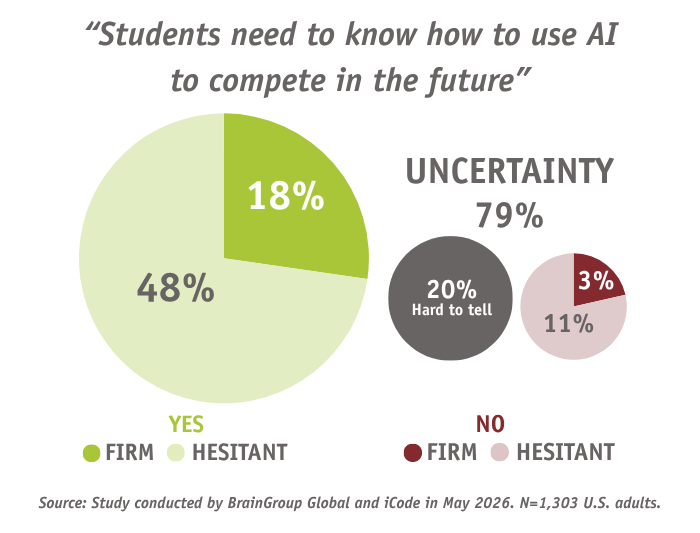
On one hand, adults believe that “some teaching should remain human-led, no matter what” with almost unanimous (87%) agreement. And yet, only 23% among this group feel certain, leaving a broad segment of the country to potentially be convinced otherwise. Even the need for students to know how to use AI to compete in the future generally appears as a matter of lip service, with 66% agreeing (only 18% responding quickly with confidence).
Is there any certainty?
Americans may be dizzy over their positions regarding political policy and technology developments, but when it comes to knowing ourselves and being confident regarding our personal lives, the metrics change to reveal far more immutable perceptions.
When queried about personal issues such as “I am satisfied with myself,” “I am satisfied with my family” or “I am satisfied with my life,” answers firmly skew positively among the majority.
Compared to reactions to earlier statements, this reflects how reaction times can differentiate depending on the issues being measured. Sometimes there is commitment and other times there is weak consensus. And yet concurrently, the levels of stated positive or negative answers can be roughly the same, masking critical differences under the surface.
Social media: A perceived villain
In the study, Americans come together most assuredly in their convictions on topics related to protecting our children from social media.
There is strong consensus in the U.S. that “parents should limit kids time on social media.” Eighty-nine percent of the nation agrees with this statement and half (50%) feel certain about it. This is not a politically divisive issue. Democrats (91%), Republicans (89%) and Independents (87%) all feel the same way, proportionately.
As adults, we recognize that social media “makes me feel connected” and that social media “is fun,” but the dark side is equally present in wide belief that social media “is addictive” and that it “negatively affects our mental health” (64% agreement and 27% with certainty).
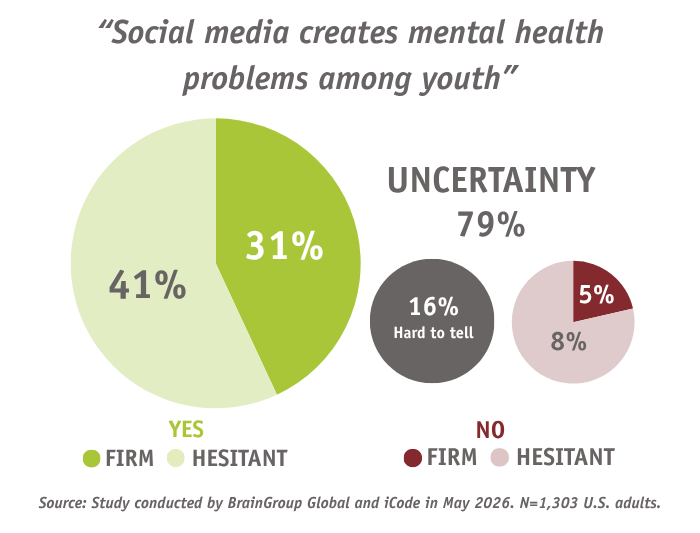
The concern over the link between social media and mental health is exacerbated when the focus is on children. The majority express at least some concern that social media creates mental problems among youth (72% agreement and 31% with certainty).
The recent recommendation of the U.S. Surgeon General’s office warning that “social media and excessive screen time pose profound mental and physical health risks to children and adolescents” is potentially a unifying rallying cry to support national, bilateral public concerns. Notably: “There is widespread agreement among the medical establishment that excessive social media use correlates with poor mental health.”
It should also be noted that the threat of social media to our children is not an isolated issue in America alone. Earlier this month, at a public opinion seminar held at the European Parliament in Brussels, a leading pollster, Michelle Harrison of Verian, connected the dangers of youth spending too much time alone in their rooms on the internet with the potential to become radicalized toward violence and antisocial behavior. This is a concern shared the world over.
Where should the next election focus?
Spanning the wide array of social issues surveyed, it is clear that America is not in sync with many of the issues that dominate the Washington agenda and the press. Perhaps surprisingly, most Americans “feel safe,” the most popular stance on immigration is that “immigrants make our country stronger” and that “America should keep it’s hands off of other countries.” There is widespread uncertainty regarding recent actions to attack Iran, and when it comes to considering the annexing of other countries such as Venezuela, Greenland or Canada, about two-thirds roughly have no firm opinion. This uncertainty also extends to how people feel about “letting Ukraine down,” with 76% uncertain.
Does this mean that America is no longer clear on what to believe in?
For Americans, the constitution remains a guiding beacon
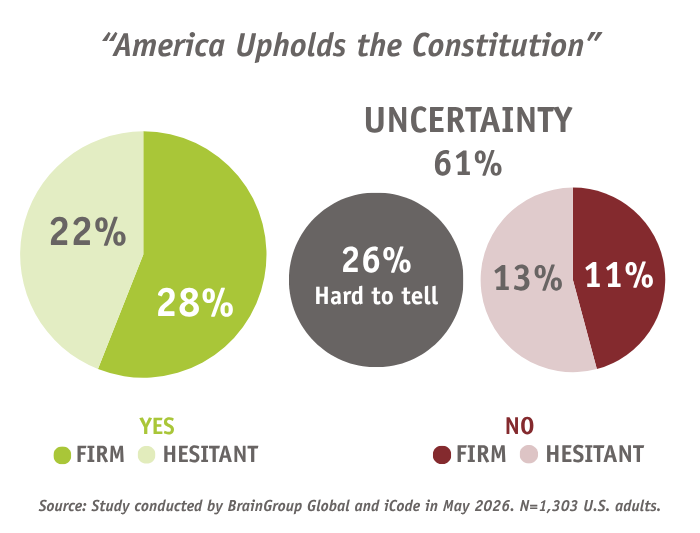
Among all 80+ opinions surveyed in this study, the one that triggered the most conviction, aside from satisfaction with self and family, is the statement “I believe in the U.S. Constitution.” A total of 85% agree, with 64% certain. This does not necessarily mean that it is perceived that America is upholding the constitution right now. However, it does reveal that in this sea of uncertainty, the U.S. Constitution provides a central guiding principle to embrace. And pride in being American continues to remain strong (74% agreement and 59% certainty). However, when it comes to reflecting upon the future, only 20% are convinced that “the world will improve in my lifetime.”
Something has eroded America’s famous “cockeyed optimism.” We live in a rapidly evolving world where technology has changed the culture and the rules. There is visible metamorphosis in behavior and policy agendas that set the world stage, with escalating concern over the economy and social safety nets.
Methodology note
The study was conducted by BrainGroup Global in partnership with iCode. The nationally representative sample of n=1,303 U.S. adult ages 18-75+ was surveyed in May 2026.