

••• consumer psychology
On the side no more
Secondary income moves from handy extra to necessity

What began as a stopgap during high inflation has transformed into a long-term financial strategy, as side hustles shape how Americans navigate rising costs, stagnant wages and economic uncertainty.
A survey by MyPerfectResume of 1,000 U.S. workers for its 2026 State of Secondary Income Report shows that for millions, side work doesn’t just fill gaps, it creates stability that their primary job can’t. Rising costs, debt burdens and uncertain wage growth have made secondary income a critical part of everyday financial survival.
Workers report earning supplemental income through: freelance or gig work (14%); investments (stocks, crypto, etc.) (14%); side businesses they own (9%); passive income (rentals, royalties) (9%); a second job for another employer (4%).
Last year’s report showed that only 5% relied solely on their main job. Today, that number is even lower, meaning side work is becoming the norm, not the exception.
Inflation may be cooling on paper, but workers are still feeling the pressure. When asked what increased their reliance on secondary income, workers cited: rising prices and inflation (29%); saving or paying down debt (11%); seeking financial stability (10%).
Almost three-quarters (72%) say inflation has made side work more necessary (up from 64% last year), while only 28% report no impact. And when asked about their personal motivations: covering basic living expenses (26%); paying off debt or loans (18%); building an emergency fund (17%); saving for a major life goal (16%); affording nonessentials like travel or hobbies (15%).
Balancing multiple income streams comes with consequences. Workers say side income has impacted them in the following ways: decline in health (21%); less time for family or hobbies (20%); increased burnout (15%).
Yet not all impacts are negative, as 28% say their workload now feels “very sustainable,” suggesting that many Americans are adapting to the two-income lifestyle.
Even if side work doesn’t make workers financially invincible, it does provide psychological security. Over half (52%) say having additional income makes them feel more secure and 68% say their side work has never interfered with ambition or availability at their main job.
Looking ahead, 54% expect to maintain their current level of side work in 2026, 32% expect to increase it while only 14% plan to scale back.
A growing share of workers no longer expect raises to keep up with inflation or living costs. In fact, 26% believe side income could eventually replace traditional raises.
That shift speaks volumes. Workers are no longer waiting for employers to close the financial gap; they’re closing it themselves through supplemental work.
Most workers expect supplemental income to become even more common in 2026: 71% predict secondary income will rise this year; half say only a significant raise could convince them to quit; 25% say they would never stop their side income at all.
The findings are based on a nationally representative survey conducted by MyPerfectResume using Pollfish in October 2025. The survey collected responses from 1,000 U.S. adults who are currently employed full-time or part-time. Respondents answered a mix of single-selection and multiple-choice questions about secondary income sources, financial motivations, job performance and future income expectations. Respondents were 43% male and 57% female. The age distribution was diverse: 8% aged 18-24, 15% aged 25-34, 20% aged 35-44, 16% aged 45-54, 17% aged 55-64, and 23% aged 65 or older. Education levels included 15% with graduate degrees, 27% with bachelor’s degrees, 15% with associate degrees, 40% with high school diplomas or equivalents and 2% with less than a high school degree.
••• health and wellness research
Still part of the regimen
Consumers sticking with vitamins and dietary supplements

As GLP-1 drugs rise in popularity, dietary supplements are holding their own, according to a recent survey commissioned by supplement maker NOW Foods. In the survey of 2,024 participants ages 18 to 65, 76% said they take vitamins and dietary supplements daily, with the remainder taking supplements at least weekly. Additionally, 44% respondents said they take more dietary supplements now than last year, while 41% take the same amount.
The survey found consumers most use multivitamins, followed by letter vitamins and probiotics. Of those surveyed, 58% reported taking vitamins and dietary supplements for general health. Rounding out the top five, other top need-states driving supplement use are: immune health; energy; gut health/digestion; and bone health/joint support.
Efficacy, safety/quality and confusion over too many choices were the top three concerns among those surveyed.
When asked what holds them back from starting a new wellness habit, cost and confusion over too many choices were the top two answers. On the flip side, having a workout buddy/sharing results and progress, app tracking and social media inspiration were the top three ways participants said they stay on track toward their wellness goals.
Taken together with consumer desires for science-backed solutions, supplement brands have an opportunity to connect with consumers via education, apps and social media. By helping them understand the benefits and making product use part of an experience or community, brands can improve their bottom line while supporting consumers on their path to health and wellness.
The survey of 2,024 participants ages 18 to 65 was conducted by research firm Suzy in September 2025.
••• ai and health care
Consent is key
Transparent use of AI OK in behavioral health settings

Americans are open to the use of AI in behavioral health when it is implemented with transparency, clinician oversight and strong privacy safeguards, according to a survey released by health technology firm Qualifacts.
The survey reveals patterns in how patients are already engaging with AI and the conditions under which they are comfortable doing so.
Key findings include:
Demand for care remains high: More than 80% say they saw a doctor or mental health professional in the past year.
Safeguards shape confidence: 77% say patients should always be informed when AI is involved in their care and 76% say it’s important that behavioral health providers meet international AI certification standards, including ISO-aligned frameworks. Privacy expectations remain high, with 60% expressing concern about AI-enabled transcriptions of doctor or therapy visits.
Administrative uses are widely accepted: 74% are comfortable with AI handling tasks such as scheduling, billing or reminders.
Clear boundaries exist around decision-making: Only 10% would trust an AI-generated medical or mental health recommendation on its own, while 37% would consider AI guidance when a health care provider remains involved, reinforcing expectations for human oversight.
AI use is already underway outside of clinical settings: Nearly 29% say they use AI tools – such as chat-based assistants like ChatGPT, Claude or Gemini – to explore mental health concerns or better understand how they’re feeling.
Trust depends on how AI is used: 47% say they trust AI either fully or in limited ways in health care, while only 9% say they fully trust it, signaling broader comfort when AI supports care rather than acting independently.
The findings are detailed in the Qualifacts 2026 State of AI for Behavioral Health report, which shows early AI adoption is already underway in mental health settings and underscores that long-term acceptance will depend less on the technology itself and more on how responsibly it is implemented, particularly when personal and sensitive information is involved.
As AI becomes more embedded in behavioral health workflows, the survey points to a defining challenge for the industry: building trust as deliberately as the technology itself. Adoption is already happening, but long-term success will depend on governance, certification and clear evidence that AI improves patient care, not just efficiency.
The data was derived from a national online survey conducted by Qualifacts via Pollfish on December 12, 2025. A total of 2,000 U.S. adults aged 18 and older completed the survey. The study examined health care and behavioral health access, attitudes toward artificial intelligence, trust and privacy concerns and expectations for oversight and international certification standards. Respondents were 56% female and 44% male. Percentages are rounded to the nearest whole number and may not total 100%.
••• shopper insights
Aisle be seeing you – in the algorithm
AI guides nearly half of today's shopping journeys

Generative AI is reshaping the first steps of the shopping experience before consumers ever click “buy.” From hyper-personalized suggestions to curated inspiration, influence now begins long before a store visit or app tap, moving where brands and retailers compete to a new level.
As reported by Dee Waddell, global head of consumer, travel and transportation industries, IBM Consulting, a new global study (Own the Agentic Commerce Experience) from the IBM Institute for Business Value, in collaboration with the National Retail Federation, found that while nearly three-quarters of surveyed consumers (72%) still shop in stores, almost half (45%) turn to AI for help during their buying journeys. Shoppers still want to see and touch products but today's savvy consumers increasingly arrive with a sense of what they’re looking for and why. They are using AI to research products (41%), interpret reviews (33%), and hunt for deals (31%).
“AI is changing how consumers shop and every aspect throughout the shopping journey,” says Caroline Reppert, senior director, AI and technology policy at the National Retail Federation. “As these technologies increasingly guide consumer discovery, comparison and choice, retailers that understand and respond to this shift will be best positioned to earn trust, relevance, and long-term customer loyalty.”
For leading brands and retailers, this shift toward AI-shaped discovery is prompting a rethink of how and where they engage consumers. “AI is turning shopping into a trusted conversation, much more than a search. Consumers now rely on assistants that feel almost human, know their preferences and offer neutral, best-for-me advice that reshapes how they validate and decide what to buy,” says Matthieu Houle, CIO at Canada-based retailer the Aldo Group.
While 35% of surveyed consumers still desire visually appealing stores with no wait times, AI-powered solutions are nearly as important. In fact, one in three consumers seek super apps that combine commerce with other services, 30% want smart homes with AI personal shoppers and autonomous delivery and 29% look for effortless purchasing through social platforms.
Consumers are growing increasingly accustomed to AI-powered shopping assistants helping them decide what to buy. That expectation, however, is forming faster than most retail operating models can keep pace, forcing the question: Is our data ready to guide and validate what customers ultimately choose? “AI is not a magic wand,” says Stanislas Vignon, head of insights (AI and omnichannel) at Louis Vuitton Moët Hennessy. “If you don't have the right data, it doesn't work. And you must test your solution to know whether it works and where it will bring value.”
As AI transforms how consumers make choices, brands and retailers need to anticipate change and intentionally design experiences that meet shoppers where they are, with focus on:
Redesigning the journey around future decision moments. Identify where consumers will use AI to research, compare and look for value and ensure those moments connect seamlessly to purchase.
Using agents to reduce uncertainty earlier in the journey. Put deal-hunting, review interpretation and personal shopping support where it will help consumers decide, not only where it deflects service volume.
Making data-readiness and testing non-negotiable. With more than half of surveyed brand executives (54%) reporting persistent challenges across channels and systems, aligning product and policy truth and testing end-to-end is essential.
Amplifying what makes the brand distinctive. Use AI to scale relevance and remove friction while preserving creativity and authentic brand expression.
Investing in AI skills and partnerships. More than half of executives (51%) cite limited AI expertise, underscoring the need to strengthen internal capabilities while partnering strategically to scale AI responsibly and effectively.
AI is reshaping where, when and how decisions are made across every industry. In retail, understanding AI-influenced consumer behavior will become a defining competitive advantage, separating brands and retailers that shape decisions from those that simply fulfill them.
The IBM Institute for Business Value conducted two global surveys in Q3 2025: one of consumers and one of industry executives. The consumer survey included over 18,000 respondents from 23 countries, representing diverse shopping behaviors. The executive survey gathered insights from 200 senior leaders across retail, consumer goods and e-commerce organizations. Respondents were segmented by engagement style, price sensitivity and AI-related knowledge. Descriptive analyses identified key patterns and validated statistical techniques were applied to compare priorities and assess trust-focused engagement strategies.
••• technology research
Upgrade slowdown
Consumers stretch the lifespan of their phones

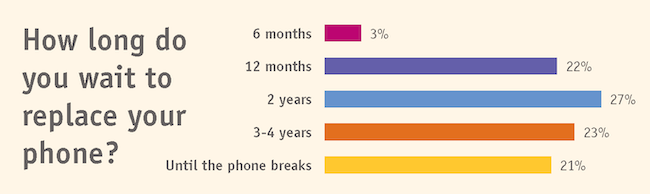
Instead of disposable tech, smartphones are now seen as long-term personal assets, extending replacement cycles and disrupting traditional industry norms. With performance, storage and battery life hitting plateaus, American consumers are no longer chasing the latest device, according to a survey conducted by Allstate Protection plans: 27% upgrade every two years (likely at the end of carrier contracts); 23% now stretch devices to three to four years; 21% delay upgrading until their phone breaks; 22% upgrade within 12 months; only 3% replace a device within six months.
As budgets tighten, consumers are redefining what “premium” means. Practicality now matters more than hype, with people choosing phones for core performance, not experimental features. For the first time, battery life has overtaken price as the top driver of purchase decisions, signaling a clear shift in what people value. The factors that matter most today include: battery life (up from No. 2 in 2023, when the last full-scale foundational survey on consumer buying drivers was conducted); price (down from No. 1 in 2023); storage (unchanged from 2023); camera quality (up from No. 5 in 2023); screen size (down from No. 4 in 2023); and brand reputation (up from No. 7 in 2023).
Despite the hype, only 17% of Americans say AI features are a big influence on their buying decisions today. However, that number is expected to grow as AI becomes more integrated into consumers' daily lives.
Despite strong interest in the environmental impact of tech products, refurbished device adoption has stagnated, revealing a growing trust gap. Consumers support the idea of purchasing used/refurbished devices (“circular tech”) but struggle to trust it: 52% say the environmental impact of smartphones is “extremely or very important;” 65% agree refurbished electronics are economical and sustainable; 37% say they are likely to buy refurbished electronics; but only 18% have purchased refurbished phones.
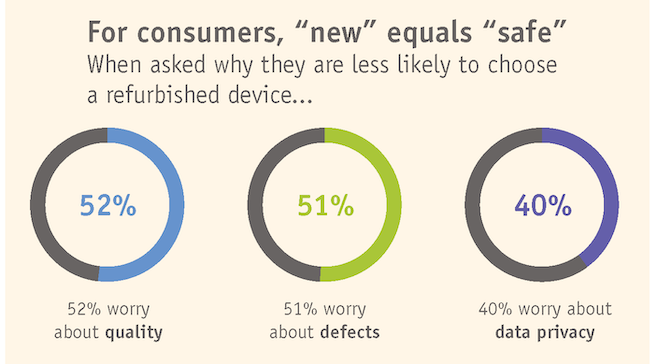
Many associate “new” with “safe.” When asked why they are less likely to choose a refurbished device, 52% worry about quality, 51% worry about defects and 40% worry about data privacy.
Even though consumers care deeply about the environmental impact of their tech, they are still unsure what to do with their old smartphones. Twenty percent recycle old phones; 8% still throw them in the trash; and 26% are not confident they know how to recycle a phone. The average household contains 1.8 unused smartphones – a sign of “sustainability inertia.”
This disconnect reveals a major opportunity for clearer recycling guidance and trade-in programs that make doing the right thing easier.
While consumers don't always act on their green conscience, they're increasingly rewarding brands that take visible responsibility for their devices' footprint: 34% say they are more likely to buy from manufacturers committing to emissions reductions; 34% say recycled ocean plastics increase purchase likelihood; 30% say recycled glass makes them more likely to buy a smartphone (30% say recycled packaging has the same effect); 27% say knowing their device will be responsibly recycled makes trade-ins more appealing.
As subscription models reshape everything from entertainment to transportation, smartphone ownership is also becoming optional. Like leasing a car, 29% of Americans surveyed say they would be likely to lease a smartphone when they next upgrade or replace their device. This “device-as-a-service” mind-set is driven by: lower upfront cost (24%); more frequent upgrades (24%); greater flexibility (21%); and the ability to include protection, insurance or repair services as part of their lease (20%).
The Allstate Protection Plans 2025 Mobile Survey was conducted in October and November 2025, gathering 1,000 responses among a representative sample of U.S. adults.