
Editor’s note: Laura Albert is a marketing data analyst at research firm CivicScience, Pittsburgh.
I don’t envy those who fight the crowds, follow teachers’ supply lists and shop around for the best deals, to the soundtrack of the kids’ opinions. Aside from the holiday season, the back-to-school season is the second most important time of year for retailers. So how are parents and students changing their buying habits and which retailers will be affected the most? And what can retailers keep in mind for next year to have a successful back-to-school shopping season?
Spending plans
Retailers saw a lack-luster back-to-school season last year and it seems this year may not be all that different. According to CivicScience data collected from July 25 through August 8, 2016, more consumers plan on spending less than they did last year on school supplies and clothing. Of the more than 3,000 U.S. adults asked, an average of 6.7 percent said they would spending more on clothing and supplies this year, compared to the 9.5 percent who said they would be spending less. However, the study did not ask how much consumers plan to spend. It is very possible that those who say they will be spending more will make up the difference – at least retailers can hope.
Bricks vs. clicks
As expected, online back-to-school shopping continues to increase. Among those planning to shop, 18 percent planned to do more than a quarter of their shopping online in 2015. This year, that number jumped to 22 percent. We can expect this trend to continue next year as convenience continues to be a major factor when shopping.
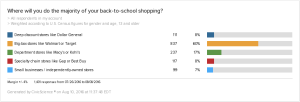
Although online shopping continues to grow, the majority of back-to-school shoppers still visit stores.

Big-box back-to-school shoppers: When compared to the general U.S. adult population, big-box shoppers have a similar gender breakdown. GenX parents over-index highest among big-box shoppers and they are more likely to live in the suburbs. 62 percent of big-box shoppers are parents – so big-box retail can expect to see some of their dollars. Big-box school shoppers are the least likely to be brand loyal when compared to the other shoppers; they may only be concerned with the deals, prices and the ease of the one-stop shop.
Department store back-to-school shoppers: Women and those with a higher than average income are more likely to say they’ll do the majority of back-to-school shopping at department stores. Baby Boomers also over-index most among department stores. Given the age of these individuals, we can expect them to be shopping for older children or their grandchildren, given that 22 percent are grandparents.
Deep discount back-to-school shoppers: Men are slightly more likely to shop dollar stores. Millennials over-index most among deep discount shoppers. Given that these consumers aren’t typically parents, they may be picking up their basic college or graduate school supplies at dollar stores.
Specialty chain back-to-school shoppers: Women are more likely to shop at specialty chains like Gap and Best Buy. They are slightly more likely to be older Millennials, aged 25-34. Fifty-nine percent of chain shoppers are parents (parents only, not grandparents), while 29 percent aren’t parents.
Shopping progress
CivicScience also tracked consumers’ shopping progress throughout the back-to-school season.

During the week of July 31, 2016 the number of shoppers who were almost done or done shopping outnumbered those who haven’t started. At the beginning of the week of August 7, 44 percent of consumers had their shopping almost done or done; 19 percent had done a little or half; and 37 percent had yet to start. So more than one-third of back-to-school shoppers do all of their shopping from about mid-August and on. Which leads me to our last topic … the last-minute shopper.
The last-minute shopper
Last-minute shoppers are defined as those who had not started their shopping as of August 7, 2016. These individuals have a higher than average income; 40 percent are 34 and under; and they are slightly more likely than the general adult population to live in an urban area. Here are a few other insights about these consumers:
- They are 63 percent more likely to read tech blogs/Web sites.
- They are 65 percent more likely to use an ad blocker on their computer.
- They are 17 percent less likely to make decisions quickly and confidently.
- They are 21 percent more likely to use Facebook daily than the general population.
- They are 51 percent more likely to regularly watch TV online.
Internet ads may not be the best route to reach last-minute shoppers since they are more likely to be blocking online ads. However, Facebook ads could be successful or advertising on online streaming services such as Hulu could be profitable.
By staying up-to-date on the latest trends and consumer preferences, retailers can develop more successful back-to-school promotions and campaigns. Before we know it, the holiday shopping season will be here (sigh). Just when we begin recovering from the back-to-school craziness.