
How habits drive consumer behavior
Editor’s note: Brant Cruz is SVP, platforms and audiences, at Chadwick Martin Bailey (CMB). An expert in global segmentation, product/service development, brand and NPS assignments, Cruz has worked with many top platforms, e-commerce, digital media, entertainment and financial services brands. Neale Martin, Ph.D., is author of “Habit: The 95% of Behavior Marketers Ignore” and “Catastrophe Theory,” and an expert in consumer behavior, working at the crossroads of marketing, neuroscience and cognitive psychology. Martin is a keynote speaker and consultant. The authors would like to thank Supriya Chaudhury, head of content strategy at CMB, for contributing to this article.
For decades, the insights industry has operated on a foundational assumption: Consumers make conscious, rational decisions. They evaluate options, compare attributes, form preferences and then choose. Our tools, models and metrics – from decision journeys to brand funnels – are built around this belief.
That assumption is frequently misguided.
A growing body of behavioral science, combined with persistent gaps between research findings and real-world outcomes, suggests that much of what consumers do isn’t driven by conscious choice at all. It’s driven by habit. Yet habit remains one of the least examined forces in consumer research.
As a result, insights teams often misdiagnose why behaviors persist, why they fail to change and why seemingly strong brands struggle with adoption, engagement or growth.
The industry’s bias toward conscious decision-making
Cognitive and neurological research shows that the intuitive, unconscious mind processes vastly more information than the executive, conscious mind and drives most everyday behavior. Conscious thought tends to intervene only when something feels unfamiliar, risky or disruptive.
Much of our research is designed to understand how consumers deliberate, which is problematic outside of the aforementioned situations. This mismatch helps explain a familiar pattern in applied research: campaigns that test well but don’t change behavior; brands with high awareness but low repeat usage; loyalty programs that enroll customers but fail to alter purchase or usage. In many of these cases, the missing variable isn’t motivation or messaging – it’s habit.
Habits are difficult to study using self-report alone. When people are asked to explain habitual behaviors, they often provide plausible rationales that feel true but don’t reflect what actually triggered the behavior.
This is a limitation of introspection. Habitual behaviors occur quickly and largely outside awareness. When asked to explain them after the fact, the brain creates a coherent story that feels reasonable.
Introducing habit as a distinct behavioral lens
A habit is an automatic behavior triggered by cues in a specific context and executed with little or no conscious oversight. Repetition alone does not make a behavior habitual; repetition that reduces cognitive effort does.
Two behaviors that look identical in aggregate data can be fundamentally different cognitively. One may require ongoing attention and reinforcement. The other may run on autopilot. Treating them as equivalents leads to flawed insights and ineffective or counterproductive strategy.
To close this gap, habit needs to be treated as a distinct behavioral construct, not a subset of loyalty or frequency. This shift reframes how we think about behavior itself.
Rather than assuming every action is a decision, we can think in terms of different behavioral states:
- Pilot behavior, where consumers are conscious and deliberate.
- Copilot behavior, where heuristics and rules of thumb partially automate action.
- Autopilot behavior, where habits dominate and conscious intent is minimal.
The same person can move between these states depending on context. A frequent traveler may be on autopilot when booking a familiar business hotel but shift into pilot mode when planning a vacation. The category hasn’t changed but the context has.
Habits don’t form randomly. They develop through a repeatable pattern that links environment, action and learning over time. We have been working to translate decades of habit science into a practical framework for applied research and strategy.
That framework centers on what we refer to as a habit cycle (Figure 1).
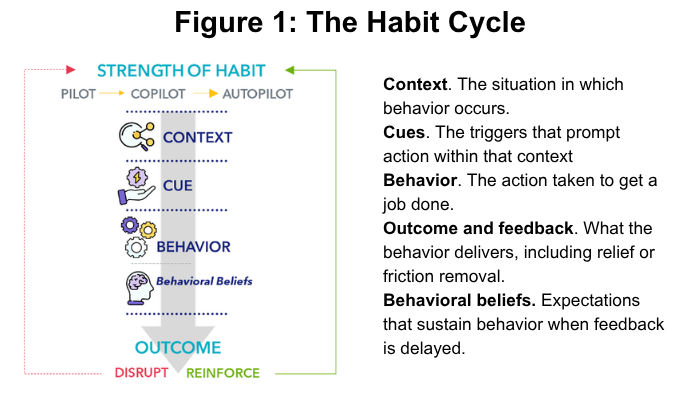
Over time, the brain reinforces behaviors that minimize effort and complexity, consistent with the law of least effort. Once established, these behaviors become faster, more automatic and more resistant to change.
Another common misconception is that habits are primarily reinforced by rewards. While rewards matter, they are only one form of feedback. Habits can just as easily be reinforced by avoiding hassle, reducing uncertainty or removing friction.
This helps explain why many habits persist even when satisfaction is mediocre. Ease and predictability can be more powerful than pleasure.
Measuring habit strength, not just usage
We recently developed a scalable approach to building a strength of habit index (SoHI) to categorize customer behaviors into pilot, copilot or autopilot. Our qualitative and quantitative modeling explores a wide breadth of measures beyond simple frequency and recency.
We identified the five key variables used to create the index. SoHI scores range from 0-100, where 0 = pilot/fully conscious decision-making and 100 = autopilot/fully habitual.
Habit-based analysis reshapes decision-making. In the case of segmentation, instead of grouping consumers solely by demographics or attitudes, behaviors can be segmented by how they are triggered and experienced cognitively. As an example, in loyalty programs, different customers may redeem points at similar rates for entirely different habitual reasons – some driven by immediacy and self-reward, others by accumulation and future-oriented thinking.
Implications for research practice
Introducing habit as a core construct has practical implications for insights work:
- Context should be central, not peripheral.
- Self-report should be interpreted cautiously for habitual behavior.
- Behavior change should be studied explicitly, not assumed.
- Small design shifts may outperform large messaging efforts.
- Measurement should distinguish effort-drive from automatic behavior.
Moving beyond the illusion of choice
The insights industry has made tremendous progress in understanding attitudes and preferences. But as digital platforms, AI and routine-driven experiences increasingly shape behavior, those constructs alone are no longer sufficient.
Habit isn’t a replacement for choice – it’s the layer beneath it. Recognizing when behavior is habitual allows insights teams to better explain persistence, predict change and design research that reflects how behavior actually works.
Author note
This article draws on original research and frameworks developed by Chadwick Martin Bailey (CMB) and research done by Neale Martin, Ph.D. The perspectives shared are not tied to any specific client engagement.