
Editor’s note: Pam Goodfellow is consumer insights director and principal analyst at Prosper Insights & Analytics, Worthington, Ohio.
With the 2016 holiday shopping season here in full force, retailers are competing with one another in a challenging environment, where consumers are expecting big discounts and free shipping at every turn, testing the ties of loyalty as they venture beyond familiar storefronts and brands in order to stretch their budgets. While holiday shoppers continue their post-recession “cautious, concerned, cost-conscious” mantra, I have identified several trends emerging for the 2016 holiday season.
Prosper Insights & Analytics conducts a monthly survey of more than 6,000 U.S. adults on their plans to spend, outlook for the economy and other macro issues, and well as retail shopping behaviors. Every October, Prosper begins its three-part series on the winter holiday season, partnering with the National Retail Federation to disseminate these findings. While each year presents unique opportunities and challenges for retailers and brands, 2016 proved to be particularly interesting, given this year’s race to the White House.
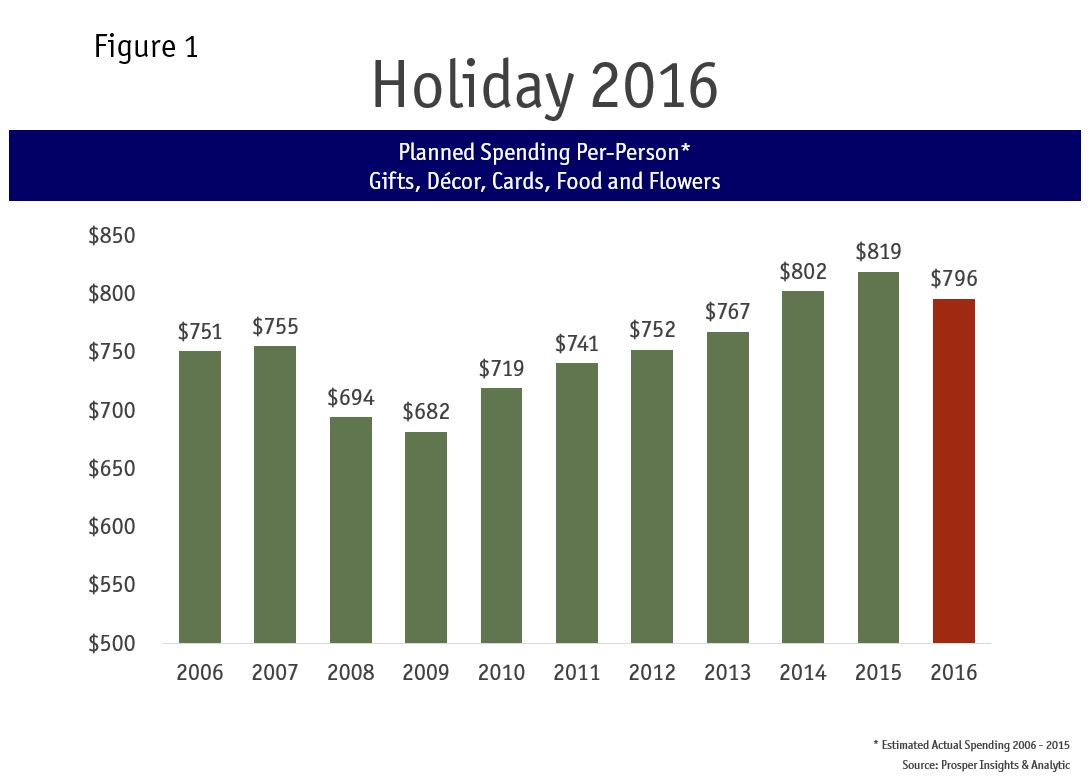
When surveyed on the topic in early October, holiday shoppers planned to spend an average of $796 (per person) on gifts, décor, cards, food and flowers for holiday 2016, down nearly 3 percent from their $819 estimated spend in 2015, shown in Figure 1. At the time, political anxiety was peaking at highs not seen since summer 2011’s debt crisis. At the outset of the holiday season, concern and frustration regarding the upcoming presidential election certainly seemed to affect consumers’ holiday spending outlook.
However, as of early November – and prior to election results – consumers seemed a little more relaxed about their overall spending plans as the final act of the election was near and the holiday season moved into the foreground. Several of our broader financial trackers indicated that consumers had become less conservative with their spending plans month-over-month and year-over-year, suggesting that, despite political uncertainty, they were gearing up for holiday spending. As such, holiday spirit will likely trump concerns stemming from Capitol Hill, though political anxiety may remain a minor headwind facing retailers this season.
Instead, retailers and brands will likely be more challenged by a lack of must-have products as well as shoppers distracted by experience gifts, such as cooking classes, concert tickets or spa packages, which aren’t typically purchased at traditional retailers. And, above all else, Amazon.com is poised to be the driving force against brick-and-mortar retailers this season. With its combination of low prices, free shipping and a unique customer experience, Amazon has been busy captivating loyal shoppers and aggressively pursuing a larger share of wallet while competing retailers are left fighting over scraps. The Amazon phenomenon, combined with shoppers’ access to on-demand pricing transparency via their mobile devices, has pushed retailers into an era of hyper-competition. The clear winner in this situation? Consumers – who won’t be forced to spend beyond what they really have to this holiday season.
There are opportunities for retailers and brands who are aligned with the right audiences and attuned to the needs of increasingly digital consumers and their evolving shopping behaviors. With this in mind, here are six trends to watch.
1. Merry Christmas to me
While consumers are planning to spend slightly less year-over-year on holiday gifts, décor, cards, food and flowers, self-gifting continues to be a highlight for holiday purchase intentions, improving more than four percent from 2015.
Key takeaway: Holiday shoppers will likely be on the lookout for items that they’ve put off buying over the past year, such as small appliances and wardrobe staples (e.g., jeans and other foundation items), as they expect some of the best deals to roll around during the holiday season.
2. The new normal
Certainly the election has caused some anxiety, but there is a greater fundamental change affecting consumers’ willingness to spend: the new normal. Since the Great Recession, consumers have adhered to cautious, cost-conscious strategies; they are conditioned to look for sales, shop around and not spend more than they have to.
Key takeaway: It’s certainly a challenge for retailers and brands to offer deep discounts to consumers while managing shrinking profit margins. Retailers who save their best deals for their most loyal or frequent shoppers may minimize the impact to their bottom lines.
3. Zero in on Gen X
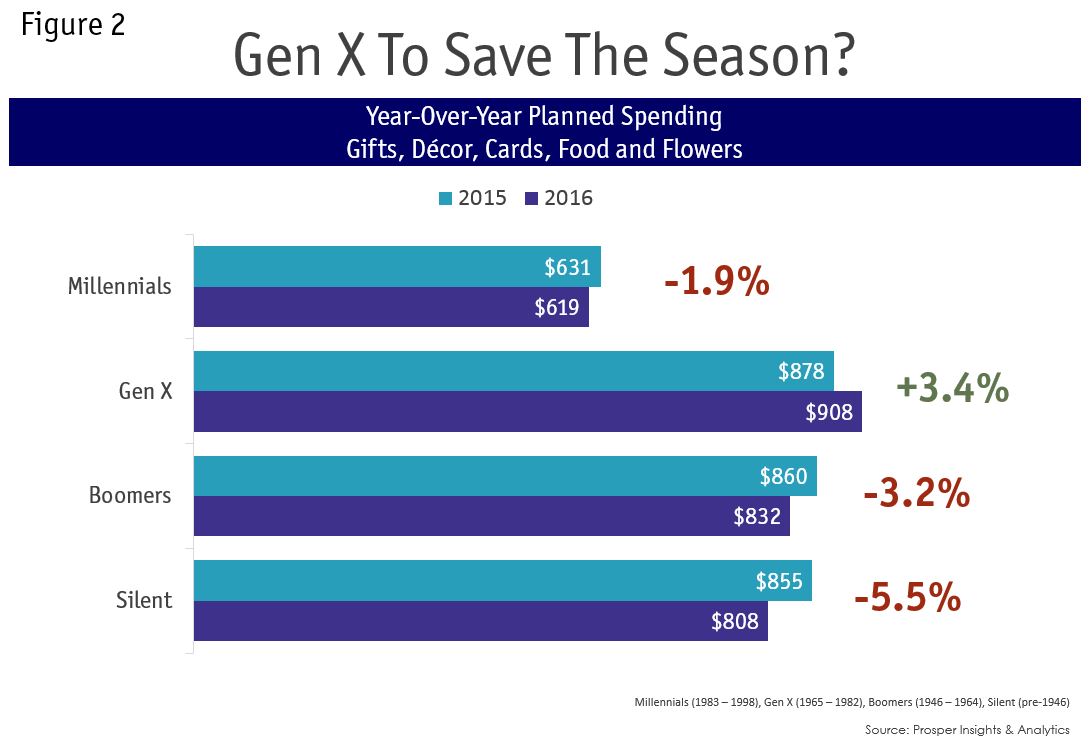
Millennials are the hot generation and on the wish lists of every retailer and brand, but the youngest generation’s holiday spending intentions are down year-over-year and pale in comparison to average planned spending per person among older generations.
Key takeaway: Retailers should be zeroing in on Gen X-ers, who are in their prime earning years and intend to spend more this year than last. This oft-overlooked generation is accounting for the largest proportion of planned gift spending; Gen X shoppers are budgeting $46.6 billion on holiday gifts this year, 60 percent more than their Millennial counterparts (Figure 2).
4. Online still a major player
Online continues to threaten brick-and-mortar retailing, as consumers are equally likely to shop at department stores, discount stores and online for their holiday purchases this year. For 2016, celebrants estimate that they will do 48 percent of their holiday shopping online, a record high.
Key takeaway: Consumers’ desire to shop online isn’t just a trend, it’s a reality of evolving shopping behaviors. Retailers and brands alike must maintain a digital presence that aligns with their brick-and-mortar personas, as shoppers do not distinguish between channels, so a bad experience online could spell the end of a relationship in-store (and vice versa). Consumers’ cherry on top of a great online experience? Free shipping.
5. Giving an experience
Gifts of experience are likely to distract consumers from reaching for more traditional gifts this year and are most popular among younger generations and affluent households. Coming from the idea that consumers have enough stuff, these outside-the-box gifts allow consumers to feel that if they are going to be spending their hard-earned dollars, it won’t be on just another sweater – it’ll be on a gift that is memorable and life-enriching for the recipient.
Key takeaway: Likely to be propelled by a lack of must-have gifts this season, gifts of experience may be a particular problem for retailers catering to younger and/or affluent shoppers. This season, consumers will be looking for reasons to spend and connections to those perfect gifts. A rigid focus on customer service excellence may help ease shoppers’ anxieties as they reach for their wallets.
6. Loyalty to Amazon Prime
Amazon continues to attract loyal shoppers via its popular Prime membership subscription. Currently, more than a third of adults have access to Amazon Prime memberships, rising nearly 30 percent year-over-year.
Key takeaway: It’s Amazon’s game this holiday season; retailers who underestimate or fail to understand shoppers’ affinity for the online giant will likely be left out in the cold.
While the 2016 holiday shopping season is well underway, it’s not too late for retailers and brands to tweak their promotional strategies to attract customers and improve their potential as we continue into the 2017. It’s also not too early to look ahead and plan for next year’s holiday shopping season.