
Editor’s note: Annette Brady is V.P., publisher development for CivicScience, Pittsburgh-based research firm. This is an edited version of a post that originally appeared here under the title, “Does product placement influence purchase of the product?”
While watching Saturday Night Live, I thought I was watching a skit with Bobby Moynihan. By the time I realized I was actually watching a paid commercial, or as it is being called: a “blended skit,” using SNL talent to promote a brand, I had already watched the whole thing. It was for Pizza Hut. Smart! Recently, NBC’s Saturday Night Live, announced that it was planning to reduce the number of ads by 30 percent next season but will be increasing the number of “branded sketches.”
Commercials are often looked upon as an interruption, mostly because they are not entertaining or engaging. We are now in a culture where we live stream programs or watch them via our DVRs, so we can skip the commercials. If networks will be reducing the total number of commercials they air, we can expect to see product placement become much more prevalent in mainstream broadcasts.
The question: Is it effective for the brands who choose to use it as a means to reach consumers and influence their purchases?
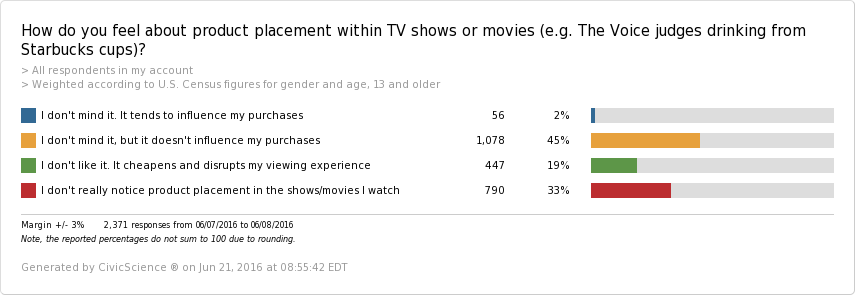
We asked over 2,300 respondents how they felt about product placement within TV shows or movies and if it influenced their purchases. Forty-seven percent of people don’t mind it. Great! But only 2 percent of them say that product placement influences their purchases, while 45 percent say it doesn’t. Nineteen percent don’t like product placement and view it negatively. And 33 percent say they don’t notice product placement at all in the shows or movies they watch.

Twenty-nine percent of the people who answered with, “I don’t mind. It tends to influence my purchases” are under the age of 18, and 64 percent are women. It will be important to pay attention to this younger generation, the iGeneration, as it grows in both size and influence.
With an overwhelming lead, 45 percent of people say they don’t mind product placement but it doesn’t influence their purchases. (It is possible that people may be subconsciously influenced.)
Here are some interesting insights about these consumers:
- 50/50 split between men and women.
- Most are Millennials and Gen Xers (32 percent are 18-34, 36 percent are 35-54).
- They are more likely to watch CNN for most of their TV news.
- They prefer to drive compact cars.
- They closely follow the NHL (lots of product placement here).
- They are more likely to go to the movies at least once a month. This would indicate that they have a better chance of being exposed to the product placement in movies.
- They are more likely to own an e-reader.
- They watch CBS more than other networks.
- They are more inclined to tell others about new brands and technology.
- Thirty-five percent of these respondents say that style and quality of products cause them to be brand loyal.
- They are more likely to watch TV.
The 19 percent of people who have a negative impression of product placement are more likely to be college graduates. These folks are also more likely to read the nutritional information of their groceries. Fifty-four percent are men, 46 percent live in the suburbs and 48 percent don’t have children. Twenty-two percent are under the age of 25, 20 percent are 25-to-34, 31 percent are 35-to-54 and 27 percent are over 55.
For the people who answered, “I don’t really notice product placement,” our research shows they are less likely to watch television programs online and are less likely to go to the movies. They are also less likely to own an e-reader. Most notably, those that chose this response are most influenced by ads they see on TV!
Let’s dig into product placement using the show The Voice and placement of Starbucks cups on the set of the show as an example. First, I crossed the question, “How much do you like the show The Voice?” with the brand placement question. Over half of the people who “love or like” the show do not mind product placement, but it doesn’t influence their purchases. Almost half of the people who don’t like the show don’t like product placement and feel it cheapens and disrupts their viewing experience. Since The Voice does a lot of product placement (Starbucks, Nissan, etc.) it makes you wonder if there might be a correlation with why they don’t like the show … a topic for another blog.
Let’s also look at the result of crossing the question, “How much do you like The Voice?” with favorability of drinking Starbucks. I was surprised to see that people who are fans of the show have a higher un-favorability rating of Starbucks at almost double what their favorability is. I was equally surprised to see that the people who are not fans of the show like to drink Starbucks more than those who liked the show.
Remember what I said at the earlier about the possibility of people being subconsciously influenced? This may indicate one of two things: they are but in a negative way, or it actually supports that they don’t mind product placement but it doesn’t influence their purchase decisions.
As networks make adjustments to cut back on the commercial loads for a better consumer experience, they must also balance that with delivering an ROI for advertisers. Based on the findings of the research, the products being placed within programs are getting noticed. Great for branding! But, it is not influencing consumers’ purchases. Brands need to either also use very creative commercials to tell their story in order to build on branding, or they need to create a promotional tie-in and encourage a call to action. Here’s a contest suggestion for The Voice and perhaps, Pepsi. Call it, “Be Original” – Millennial consumers post a picture of themselves sitting in a red chair holding the new Pepsi 1893 can, with #TheVoicePepsi1893. This automatically registers them to win a trip to the final live show of The Voice where they can take a picture in an official red chair and can post it to social media. To further encourage sales, everyone who posts could also get a bounce-back coupon for the new Pepsi 1893.
Either way, the end result must be an increase in sales otherwise, what’s the point?