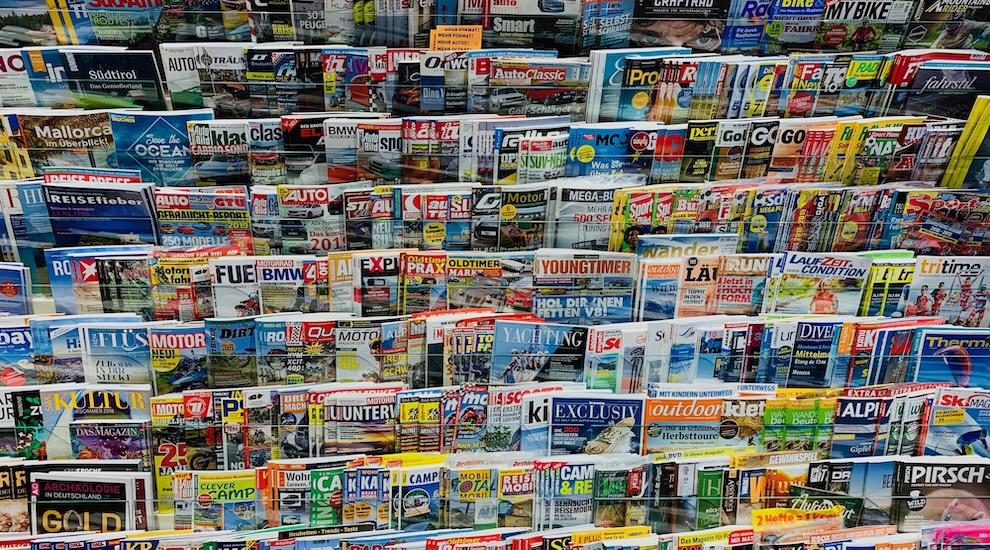
Physical media in a digital world
Editor’s note: Tanya Pinto is the principal UX researcher at Microsoft and president of Baal Dan Charities. Find Pinto on LinkedIn.
There's something almost rebellious about pulling a physical magazine out of your carry-on in 2026. As I settled into my window seat on a recent flight from Seattle to Dallas, I reached past my laptop, past my tablet, and grabbed something that felt almost anachronistic: the 400th edition of Quirk's Marketing Research Review.
The joy of paper in a pixel world
Like most of us in the insights industry, I spend the vast majority of my days consuming information on screens. Reports, dashboards, articles, messages … an endless stream of digital content competing for my attention. But somewhere over the Rockies, with my phone in airplane mode and my laptop stowed, I rediscovered something I'd nearly forgotten: the immersive pleasure of paper.
There's a different quality to reading print. No notifications. No temptation to check "just one email." No algorithm serving up the next distraction. Just me, the magazine and four uninterrupted hours to think about what I was reading.
The lost art of annotation
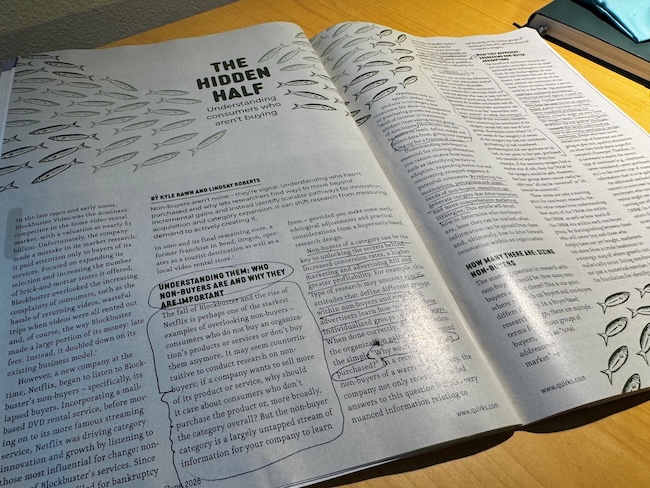
I'm a firm believer that reading without annotation is like cooking without tasting. I need to engage with the material I am reading to retain it. I do this through underlining key passages, circling insights that surprised me, adding asterisks to ideas I want to revisit. Annotating helps to go from passively consuming to actively learning.
By the time we touched down in Dallas, my copy of Quirk's looked like it had been through a research workshop. Margins filled with notes. Pages dog-eared. Key statistics underlined twice. This is how information moves from short-term memory into something you can actually use. There's research to support this, of course, but sometimes the best evidence is simply noticing how much more you remember when you've physically interacted with the material.
The research: Mueller and Oppenheimer's landmark 2014 study in Psychological Science found that handwritten note-taking leads to deeper conceptual understanding because it forces us to process and reframe information rather than passively transcribe it.
This wasn't just any issue. The May/June 2025 edition marks Quirk's 400th publication! A remarkable achievement in an industry that has seen countless publications come and go. Four hundred editions of curating the best thinking in market research, connecting practitioners with new methodologies and documenting the evolution of our field. That alone made this issue worth savoring.
Three key insights from 30,000 feet
Several articles stood out during my flight, and I wanted to share a few insights that have stayed with me:
- MaxDiff deserves a closer look: Carl Jago's refresher on "MaxDiff" myths was exactly what I needed. Too often, we treat familiar methodologies as solved and stop questioning our assumptions. Jago's piece reminded me that even well-established techniques like best-worst scaling have nuances that deserve ongoing attention. The method's elegance lies in forcing real trade-offs rather than letting respondents rate everything as important.
- The hidden half matters most: Kyle Rawn and Lindsay Roberts' piece on "The hidden half" reinforced something we all know but frequently forget: What consumers say and what they do aren't always the same. The hidden motivations, the unarticulated needs, the behaviors people can't or won't explain is where the real insights live. Numbers tell us what's happening; understanding the hidden half tells us why.
- Identity shapes everything: David Intrator's exploration of consumer identity struck a chord. In an era where consumers increasingly express who they are through what they buy, understanding identity isn't optional, it's foundational. Eric Tayce's work on "Upcycled Segmentation" and Eric Karofsky's "Running to Stand Still" reinforced that our frameworks need constant refreshing to remain relevant in a rapidly shifting landscape.
Take your Quirk’s with you
Here's my challenge to you: Before your next flight, download a PDF or better yet grab a physical copy of Quirk's. Put your devices away. Bring a pen. Give yourself permission to read slowly, annotate freely and think deeply.
In an industry built on understanding human behavior, sometimes the most valuable research is the kind we do on ourselves. The insights are on the pages. The magic is in the margins.