
Editor's note: Doug Berdie has been a research professional since 1971, specializing in survey research and customer service. He’s designed and overseen projects for Fortune 100 companies in dozens of industries. Besides business clients, Doug has served government, non-profit and educational clients. He founded and managed two research companies and has taught at two universities. He was senior author of “Questionnaires: Design and Use.” Find Doug on LinkedIn.
It is axiomatic that rewarding customer satisfaction score increases leads to gaming the system. Employees select samples of “known to have favorable opinion” customers to be surveyed and suppress “known to be negative” customers from the survey samples. Many retailers try to influence their CSI scores by cajoling customers in various ways to, “Give us all 5s!”
Psychologists are not surprised by this behavior. It is well acknowledged that humans are highly creative in getting what they want. And, if their compensation or other rewards are based on getting high scores, they will find ingenious and effective ways of doing so.
In addition to not getting real scores, the other problem with rewarding CSI scores is that it focuses everyone’s attention on the wrong thing – a number rather than actual customer service.
There is a better way – one that has been shown to work:
- Use the CSI scores to identify the elements of the customer experience that need improvement.
- Create action plans that will lead to the desired improvements.
- Get buy-in on the action plans from the people who will need to implement them and from their managers.
- Give the implementers the support and tools they need to put the plan in motion.
- Have the implementers prove they undertook the plan as agreed to.
- Reward the plan’s implementation.
- Use subsequent CSI measures to see if the plan implementation did make a difference.
The benefits of this method are:
- Employees focus on changing behavior and systems to better serve customers – not numbers.
- Employees are rewarded for doing what everyone agreed should make a difference (if it doesn’t, it’s not the implementors’ sole fault; others agreed, too).
- Subsequent CSI numbers show whether certain actions do work. If they work, they can be continued and expanded upon and if they do not work they can be amended or dropped.
- No one cares about rigging the numbers, so numbers can be used as indicators that have real meaning.
We used this approach over the years with great success among a variety of past retail clients. In all cases, we saw more improvements in program-participating sites than in other sites. The numbers in the accompanying tables are typical of implementation results at a client with more than a thousand retail sites. (Participation was voluntary.)
ROI analyses showed that the sites that undertook the whole process (did the diagnostic measure, defined a plan mutually agreed to by the site and upper-level managers and implemented the plan) saw proportionately more of a sales increase (across their entire product base) and less employee turnover than did sites that did not do the entire process. The differences were huge (see tables).
And, not unexpectedly, participation led to higher customer satisfaction scores.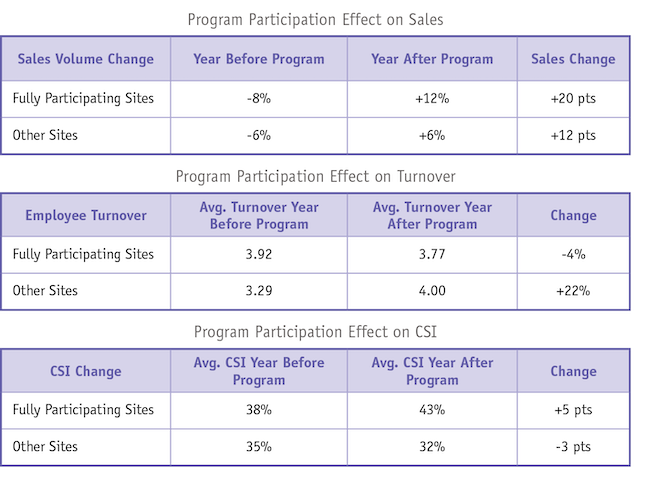
One of the keys to this program was that the individual retail site managers were compensated via incentives for implementing the action plan they had designed cooperatively with their managers. This rewarding of action differed from the usual practice of rewarding increased scores (which can deflect attention from action). And, as shown in the average CSI data, success in implementing action plans did, in fact, raise the scores that indicate ROI improvements.
It's always challenging to introduce new actions into businesses and much easier to just record and chase numbers. But we should always remember that actions speak louder than CSI scores! And there is great satisfaction among both employees and management when they see that implemented action plans do in fact increase sales and employee satisfaction (as evidenced by decreased turnover). Following the program strategy described above can require a lot of effort but the results pay off!