Q&A with Kevin Karty
Editor’s note: Nancy Cox is the founder/principal at Research Story Consulting, LLC, Kansas City, Mo., with over 30 years of experience in effective writing and research methodologies. She holds a Master of Liberal Arts in business admin and management, and a Bachelor of Science in journalism. Find Cox on LinkedIn.
Passions, hobbies, healthy distractions and even guilty pleasures – discover how the research community plays and how that plays out in their work life. In the Venn diagram of work and play, what happens when they overlap? Research colleagues share their work and play stories in this interview series by Nancy Cox.
Hello Kevin Karty, CEO and Co-Founder, Intuify
What is the “play” in your life?
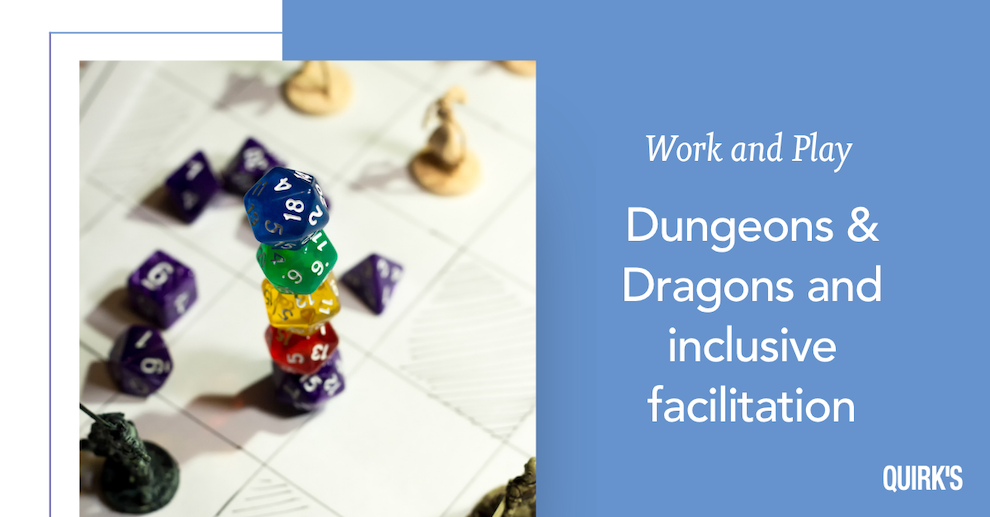
I play role-playing games (RPGs). The one that I play the most, and for the longest amount of time, is Dungeons & Dragons (D&D). All the way back to first edition up to now, in post fifth edition. I was the nerd in high school and college. When everyone else was going to parties, I was stomping orcs. Today, I connect with my college friends scattered all over the country as we play D&D on Zoom.
D&D is a game of structured storytelling. Typically, there’s a Storyteller, sometimes called Dungeon Master (DM) or Game Master, who provides the background story and background world in which each person plays a character. Players have purchased world books and rule books that define characters’ abilities. But the team has a lot of liberty to adapt or make up story elements – as long as you’re telling a fun story, keeping people interested.
Character abilities go beyond defeating an enemy or slaying dragons. A character could have the ability to persuade a judge to free somebody because they’re not actually a witch. There are challenges beyond combat. For example, there are stories modeled after movies such as “The Great Escape.” There are heist adventures to steal something from an evil merchant which require using abilities beyond combat – trickery, ability to disguise, level of sneakiness. The Storyteller determines what might interfere with heist plans – guards’ abilities to reduce sneakiness or maybe magic traps.
All these elements make it different from RPG video games where you’re going through somebody else’s story. In tabletop games, you’re working with your friends to actually write your own story or story variation.
The game has evolved from pencils and paper, a dog-eared manual book and maybe some dice. The rise of streaming gaming communities, such as Twitch, introduced live streams of D&D games with some even casting professional voice actors. Thousands of people watch these games. Recently, Amazon has turned some of these voice-acted live streams into animated series including “Critical Role” and “The Mighty Nein.”
How has your play influenced your research work?
Dungeons & Dragons was not something talked about in a professional environment until maybe five or six years ago. There was a stigma attached if someone identified you as a role-playing gamer. Now it’s almost cool, especially with Gen Z who became aware of RPG games through very popular TV shows such as “The Big Bang Theory” and “Stranger Things,” which include gamers. It’s a way to build real-world connection with people.
As researchers, we need to be aware of this gaming influence on culture. Both what influenced the games and how the games now influence. There’s a full circle connection with popular literature. D&D was obviously inspired by Tolkien’s “Lord of the Rings” and Robert E. Howard’s “Conan the Barbarian;” fantasy books that created an entirely new genre. But D&D has in turn influenced modern TV shows, movies and literature.
D&D is a great way to become familiar with classic story arcs beyond the quest arc. Redemption arcs are a common theme. A character who did something bad trying to redeem themselves. Or a character who was wronged and ultimately faces the choice between revenge or pursuing another objective. You get a chance to play those arcs, to explore different choices. The choice appears as A or B but the fun in being a player is coming up with a new choice or a combination. How many times have you been watching a movie and thought – why didn’t they just do this? Well, in role playing games you can flip the script.
You’re training to look for out-of-the-box solutions. I’ve faced a choice at work and asked myself, what would my character do in this situation? An interesting way to step out of my work self, who’s narrowly focused on the immediate problem. First, it de-stresses me, especially when the problem seems unsolvable. Second, I see a bigger picture or a different picture through this new lens. I don’t always get an answer but simply the break into other ways of thinking is helpful.
No doubt that D&D has made me a better facilitator as including everyone is absolutely essential to RPGs. I’m always asking critical facilitation questions. What are the other players thinking? Am I including everybody? Is this person being excluded? Are they getting the chance to tell their story? Developing a constant sense of awareness and sensitivity to all the other players. Yes, you have your own objectives, but you respect others’ objectives. Sometimes you realize your objectives aren’t really the focus – you’re playing support cast while someone else takes a turn in the spotlight. Not unlike when your research leads to a very different focus than your final objectives.
Perhaps surprising to those who only know of the combat aspect, D&D encourages cooperation more than competitiveness. You may have conflicts with the other players, but the conflicts are intentional parts of that character, not the person. Playing a character that is dark and mysterious with a grudge on their shoulder can create conflict or provoke arguments. It’s OK to have intense arguments with players in character because the argument does not go outside of the character.
What would you tell readers who want to know more about your area of play?
Find out if the game is intriguing to you, something you might enjoy, by going on to Twitch or searching for live-stream D&D to watch a game. If you are interested, you’ll need to find a group. Local gaming shops still exist because game companies have done a good job preserving them. These shops often host gaming sessions. Local gaming websites post meetups for those looking to form a gaming group. You may try several groups because the fit varies – some groups are hard-core kill the orcs and other groups might not even do combat, with a lot of groups somewhere in between.
D&D is one of the cheaper hobbies – not like playing golf! Playing D&D for a year is less than what you’d pay for the cost of one ticket to one NFL game. Start out buying a few books – “The Players’ Handbook,” “The Dungeon Master’s” or “Storyteller’s Guide” – and maybe some additional adventures plus a monster’s book. About $100 total. Hasbro owns D&D and has open-sourced parts of it so there is additional content for free online. It only gets expensive if you do something like attend a convention.
I think about conferences such as the Quirk’s Events sponsoring a game night. At the end of an informative but exhausting day, playing a game can be an easier way to be social as it’s a bit guided. It doesn’t have be Dungeons & Dragons. It could be a Live Action Role Playing (LARP) game such as murder mystery LARP. “Who killed Dan Quirk? Who stole his chimes?” I totally feel we could convince Dan to play a dead body on the floor.