
Upcycled segmentation
Editor's note: Eric Tayce is a vice president in Burke’s corporate innovation group. He brings more than 25 years of experience helping organizations uncover unmet needs, create meaningful innovations and translate insight into new products, services and growth opportunities. He holds an MBA from the University of Kentucky. Find Eric on LinkedIn.
Front-end product innovation isn’t hard because teams lack creativity; it’s hard because the situation lacks clarity. After all, it’s called a “fuzzy” front end because it lacks definition.
In the earliest stages of product development, when every direction feels possible, segmentation is often pulled in as the compass that turns ambiguity into forward progress. Segmentation feels like progress because it provides direction on who they’re building for and why those people choose (or don’t choose) a solution. I think segmentation is the right tool, but the challenge I often see is that my clients’ stakeholders want the speed and flexibility of an entrepreneurial start-up, right alongside a level of analytical rigor that’s only possible with large samples, tight validation and minimal ambiguity. This incongruous juxtaposition can push insights professionals into a state of “precision paralysis,” where the project requirements themselves create a bottleneck in the process. The way out? I propose it’s through a segmentation approach that embraces the idea that, in some cases, “good enough” can actually be better than perfection.
Segmentation has long been a gold standard technique in the marketing research world and for good reason. Targeting groups of consumers with similar needs has been a cornerstone of marketing strategy since it was introduced in 1956. It has stuck around because it worked and it still does. However, the mistake is in thinking this gold standard cannot change. “Real” segmentations don’t necessarily need a blank slate, edgy surveys, big samples or complex clustering algorithms. That’s because when we insist on finding a 100% fresh perspective, we ignore the fact that organizations are already sitting on high-value consumer evidence in the form of CRM logs, UX transcripts, customer service records, digital analytics and past U&A work. What teams need is a way to synthesize existing, high-signal data into actionable insights. I call it upcycled segmentation.
Upcycled segmentation is a way to cut the long cycle times without being forced to make decisions while flying blind. Think of it as creating purpose-built segmentation hypotheses assembled from existing high-signal data. When done right, they give innovation teams the ability to pressure-test ideas now instead of next quarter. The goal here isn’t to replace more rigorous approaches but to create decision-ready guardrails that are clear enough to guide choices in early-stage innovation. From there, when capital, scope or risk increases, you graduate to a gold-standard approach but with sharper hypotheses and better screeners because you’ve already learned what truly matters.
The five-step upcycled framework
To be clear, upcycled segmentation isn’t a "lite" version of segmentation based on primary research data and a clustering algorithm; instead, it is a purpose-built approach that delivers targeted strategic direction at the speed required of successful innovation. An upcycled segmentation is provisional in the sense that it is a working hypothesis designed to get your team out of the lab and into the market. Implementing this kind of approach requires shifting the workflow from data collection (i.e., the answer is out there and I need to find it) to data architecture (i.e., the answer is in here and I need to retrieve it). Following these steps will get you a little farther down the path toward reaching that reality.
Step 1: The decision audit
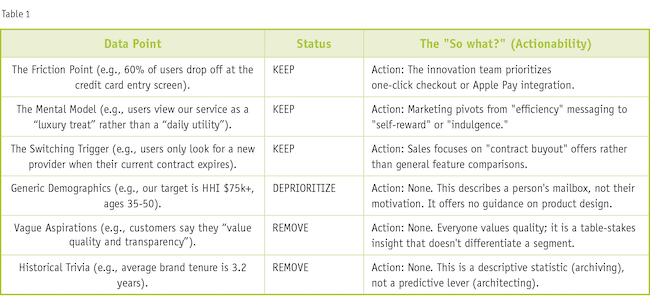
The first move is to work backwards from the leadership team. Before you start exploring the data in hand, ask: "If we knew [X] about the consumer, would we actually change the product or the marketing?" The objective here is to segment the decisions available to the innovation team, not just the people in the database. In practice, that means if a data point doesn't have the power to pivot a strategy, it doesn’t belong in your provisional segment. Table 1 provides a few examples of when you may want to keep, deprioritize or remove data points.
 Step 2: The data scavenger hunt
The focus of this step is on exploring internal silos to locate high-signal data fragments that already exist but have never been synthesized. You are hunting for evidence of consumer behaviors or decision points that could bring new insight if connected to your larger data ecosystem. When gathering and analyzing these disparate data points, you will begin to see outlines of potential segment schemes that may support your decision-making – all without ever launching a new survey. Here are three areas where we tend to find the most valuable (i.e., drives a decision) data fragments:
Sales/customer experience: Analyze the most frequent cancellation codes, reasons for return or recurring complaints logged in help-desk tickets. These are direct indicators of consumer friction.
Research and development: Review the performance trade-offs made during the initial prototyping phase. Knowing which features were stripped out reveals what the business believes it can deliver and what it believes about its customers' priorities.
Digital marketing: Audit recent A/B testing results to see which value propositions or creative hooks yielded the highest click-through rates. These clicks are strong evidence of what motivates your audience to act.
Step 3: Pattern synthesis (the AI/human mix)
Once you have gathered your fragments, your goal is to find the themes that tie them all together. Before doing this, I apply the 3 Cs framework that I outlined in a previous Quirk’s article. This framework ensures your data COVERS the entire topic, is CURATED to remove noise and is given the right CONTEXT to execute the analysis. Once data are properly prepared, you can leverage AI to run the analysis (and I wholeheartedly recommend you do) but keeping a human in the loop is absolutely critical. Large language models, when analyzing multiple sources of information, can inject many more sources of error than simple hallucinations. To guard against this, I think it’s critical for a subject-matter expert to direct the entire analysis and build on AI output to deliver the highest-fidelity recommendations.
Step 4: The naming game
If you feel this next suggestion is ridiculously simple, you may be underestimating the power of your own marketing: Start choosing labels that clearly describe the barrier the consumer faces or the motivation that is driving their decisions. Aiming for names like Friction-Averse Optimizer ensures developers know exactly what to do by removing every unnecessary click from the user interface.
Catchy, cute names that communicate limited information will not create buy-in among stakeholders looking to take action. That’s because labels like Carefree Cathy and Fed-Up Fred offer no utility to a product team and they have little room to adjust as segments evolve.
 Step 5: The micro-validation loop
Although I’ve been trumpeting the value of using existing data, I want to insert a caveat. Before you put your reputation behind an upcycled segmentation solution, do yourself a favor and run the gut check. This could be as simple as a 48-hour “qualitative at scale” exploration among a small, targeted group of consumers. The goal is part validation (pressure-test the logic) and part illumination (support internal communication). If the segments hold water in these customer conversations, they are ready to be used as guardrails in the innovation lab.
While upcycling data allows you to move much quicker, I am not suggesting it is an excuse to abandon rigor. Synthesizing disparate datasets into a new whole requires a structure that survives real-world pressure. Here are three stumbling blocks that can limit the value of provisional segmentations or even turn them into liabilities.
The recency bias trap: In the quest for speed, teams often over-weight the newest data point because it feels most relevant. If a dozen qualitative interviews from last week contradict two years of behavioral CRM logs, the interviews shouldn't automatically win the day. Upcycling requires a weighted mind-set. Fresh qualitative data should explain the “why” but not if it derails the “what” established by your larger behavioral datasets.
The inertia risk: Insights leads need to ensure provisional segments are understood as a bridge rather than a semipermanent residence. When an upcycled segmentation is successful and easy to use, stakeholders may attempt to bake it into long-term corporate strategy to avoid the cost of a primary study. This creates "innovation debt" by prioritizing cheaper, more immediate convenience over deep, breakthrough insight. Sometimes you really do need to do the work.
The logic gap: Upcycled is not the equivalent of untested. Just because the data already exists doesn’t mean all the connections are known or even self-evident. Every segment needs a defensible thread of logic connecting the behavioral anchor (what they did) to the attitudinal overlay (why they did it). If you cannot observe and explain the connective tissue between a customer's help-desk ticket and their last purchase, your segment is likely just data noise that is being mistaken for a signal.
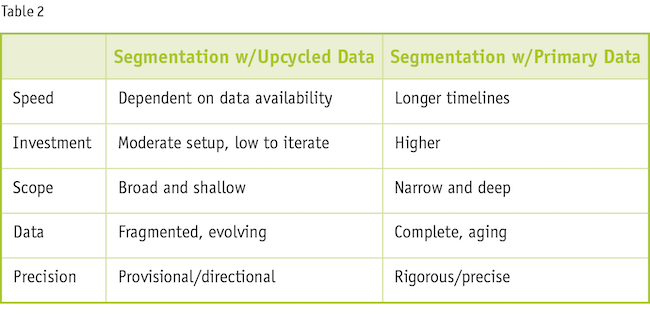
Choosing an approach, of course, should be based on a clear understanding of what each methodology can and cannot do. Table 2 summarizes a few of the strategic trade-offs between these approaches, to help you determine which tool is best suited for your specific needs and constraints.
The graduation path: When to spend the big bucks
Upcycled segmentation gives you the direction you need to start the journey but it doesn't always provide the exact coordinates for finding the destination you might seek. Once you’ve determined where you’re headed, it’s time to transition from a provisional upcycled model to a gold-standard primary study. Knowing when to make that shift usually involves three factors: capital, scope and risk. If your innovation requires a massive capital expenditure, a global launch across diverse cultural markets, organizational restructure or a brand-altering pivot that could alienate your core base, then it is time to invest in a primary study with the enterprise-level precision a CFO might demand.
A benefit of an upcycled approach is that you begin your gold-standard project with a validated set of hypotheses, refined screeners and a clear understanding of the behavioral anchors that truly matter. Pre-verified variables ensure respondents align with the most critical sample characteristics, while the existing data foundation enables a condensed survey design focused exclusively on deep attitudinal probing. Plus, starting with a "Version 1.0" model allows the project to prioritize stress-testing established hypotheses instead of capturing potentially spurious information, enabling the innovation team to more quickly move from raw discovery to validated strategic direction.
An important note here is that finding a research partner who can execute this "architecture-first" approach requires a shift in vetting criteria. Traditional agencies excel at managing large-scale data collection but upcycling requires a partner who functions more like a combination of a strategic consultant and a data engineer. Here are five areas to consider in your vetting process:
- Data synthesis: Ability to merge disparate internal silos and legacy studies into a unified strategic narrative.
- Augmented intelligence: Subject-matter experts leverage AI-driven tools to maximize speed and minimize drift.
- Segment validation: Toolkit that includes agile qualitative and quantitative techniques for rapid pressure-testing.
- Strategic consulting: Process to map your available innovation levers before recommending a specific data collection methodology.
- Iterative design: Understand how to build upon your upcycled findings rather than insisting on a “clean slate" primary study.
Place smarter bets
Precision paralysis during the front end of innovation tends to fade once teams think critically about what segmentation needs to do at this stage. In early stages, the job is to create decision-ready guardrails that help product teams place smarter bets, learn faster and stay aligned as the work evolves. Upcycled segmentation offers a practical path to do that by treating existing customer evidence as a strategic asset. When you build segments this way, you make progress without pretending the first model is the final one. Then, when the stakes rise, you can invest in a primary study with sharper hypotheses and stronger screeners because you already have the groundwork laid. The result is a segmentation approach that keeps innovation moving at the right pace and makes the later rigor more targeted, more defensible and more worth the cost.