
••• travel research
Booking stressors alleviated by technology
AI becomes preferred vacation planning tool
Looking for a getaway? Ask AI. According to a survey conducted by Qlik, the majority of Americans turn to AI as their go-to travel planning resource. Instead of trusting human agents or travel websites, people tend to rely on the burgeoning technology for help.
The race is close, however, with 58% of travelers using tools such as ChatGPT, Gemini and Claude, and 55% relying on traditional travel websites. AI is piquing interest, as 35% of travelers plan on using it in the future for planning purposes.
Despite AI’s relatively young age compared to competitors, almost two-thirds (65%) of respondents trust AI-generated travel recommendations to some degree, including 17% who would book travel solely on AI’s advice. Another 26% use AI to spark travel inspiration.
About four in 10 respondents (41%) report using AI to feel more organized and confident in their trips. Almost one in three (32%) feel less overwhelmed while planning and are more comfortable trying unfamiliar destinations or experiences. Another 31% say AI is helpful for choosing destinations, accommodations and activities that are personalized to them and their desired vacation.
More than half of travelers (56%) are willing to share personal information such as budget information, location, past booking history, passport information and credit card details with AI tools in order to receive more personalized recommendations and real-time assistance.
Younger generations are more comfortable sharing personal information, with 66% of Gen Z and 63% of Millennial travelers being willing to disclose details compared to 55% of Gen X.
When it comes to budgeting, 41% of AI users say AI helped them stay within their budget and 33% spent less than expected on travel bookings and activities. Almost one in three (28%) found lower-cost transportation alternatives and 26% saved money on gas or fuel prices. 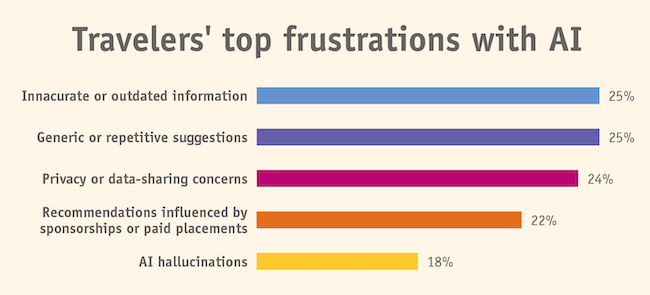
Trust is not yet completely built with consumers. Their top frustrations with AI in their travel planning include inaccurate or outdated information (25%), generic or repetitive suggestions (25%), privacy or data-sharing concerns (24%), recommendations influenced by sponsorships or paid placements (22%) and AI hallucinations (18%). Another 15% say AI mistakes significantly disrupted or ruined their travel plans, discouraging them from using the tools for future planning.
The research was conducted by Censuswide, among a sample of 2,001 respondents aged 18 years or older who are planning a trip this year. The data was collected between June 5-9, 2026.
••• food research
Produce is king
Fresh is a competitive advantage for physical retail 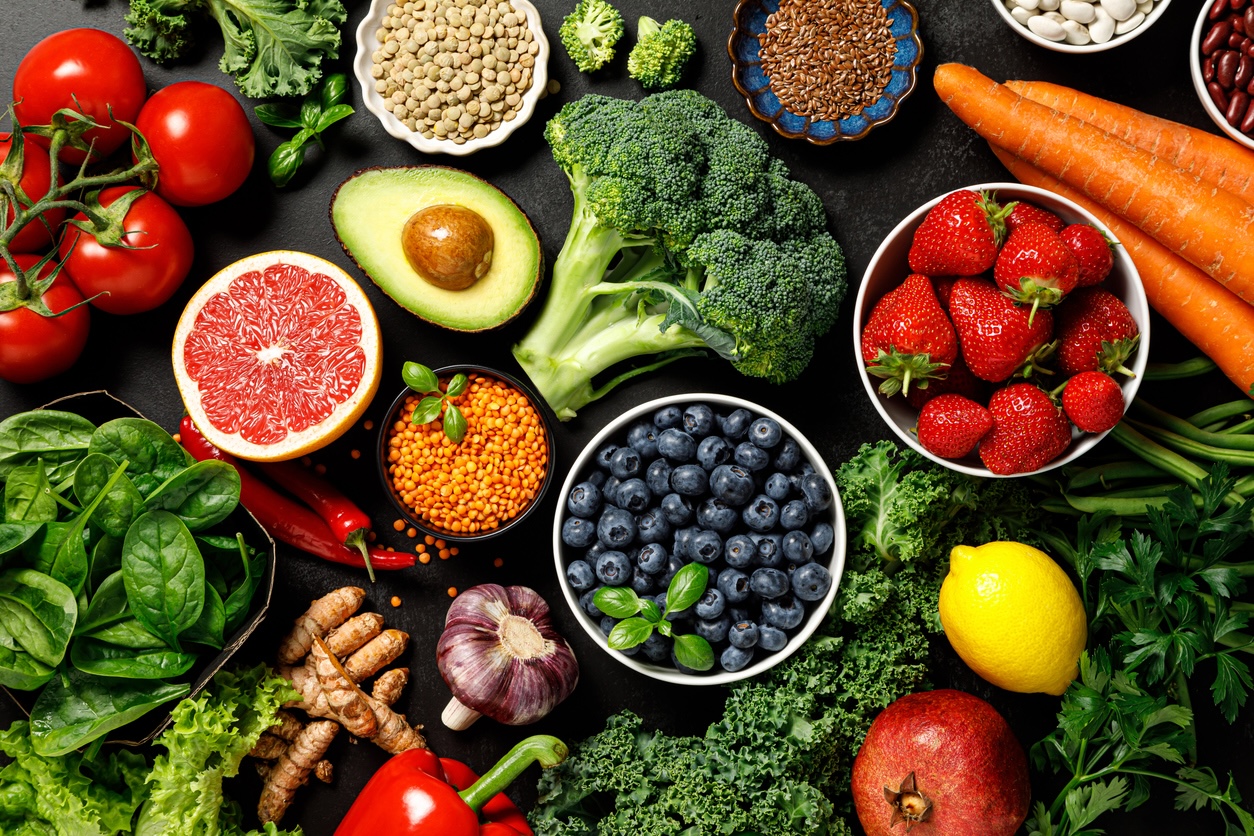
In an environment where consumers have seemingly unlimited choices, grocery retailers have to fight for loyalty. Research from Logile Inc. shows the true difference-maker is the freshness.
Over nine in 10 respondents (91%) said the fresh departments strongly influence whether they trust a grocery store, citing produce, deli and bakery execution as the clearest signal of quality. Seventy-eight percent said they have shopped at a different grocery store because its fresh departments looked better. This includes 25% who said they do this frequently. A mere 5% say they have never switched stores due to freshness.
Brand impressions can be influenced by just the produce department with 84% of respondents saying a poorly maintained fresh section impacts their perception of the entire store.
When convenience is the same, 46% of shoppers will choose the store with better fresh departments over the 40% that will choose the one with lower prices. This challenges the belief that price is paramount.
Despite the ease that online grocery shopping presents, 74% said fresh food is a main reason they continue to shop in physical stores. Freshness matters more than convenience.
Freshness is mostly measured by appearance and visual cues directly influence what goes in the cart: 85% of respondents say the appearance of their produce significantly impacts their purchasing decisions. .
Once convinced to enter the store, 68% of shoppers said hot prepared meals would encourage them to make a purchase from the deli or prepared foods section. This opens the potential for increased spending.
The Logile 2026 State of Fresh Grocery Shopping Report is a consumer survey about how fresh departments affect grocery shopping behavior. Logile worked with Pollfish in March 2026 to survey 1,000 U.S. consumers ages 18+ about fresh food departments, store trust, shopping frequency, prepared foods and in-store grocery habits.
••• travel research
Checking into new experiences
Generational gaps expose differing hospitality preferences
Younger travelers are increasingly attracted to vacation rentals as opposed to hotels while planning trips. Alchemer’s 2026 Hospitality Benchmark Study revealed that 64% of travelers 61 and older plan to book mostly hotels in the next year, with just 11% leaning toward short-term rentals. On the other hand, 37% of travelers under 30 prefer rentals versus 29% who prefer hotels.
The world of hospitality is changing, with rental sites such as Airbnb and Vrbo retaining brand loyalty. Short-term rentals score over three percentage points higher than hotels in both the positive experience (93% vs 96.4%) and very positive experience (66% vs 69.2%) categories.
Travelers’ response to a positive experience is also different. Rentals turn more guests into promoters (60.9% vs 55.5%) and produce fewer detractors (10% vs 13.7%). This leads to greater loyalty and brand recognition.
Despite this, hotels still win on near-term intent: 42% of travelers over 40 plan to book mostly hotels in the year ahead, versus 23% mostly rentals. Older travelers anchor that gap as they book a lot of rooms.
Vacation rentals may be favored today, but hotels still fill more beds tomorrow. This trend may change as those who prefer rentals are those with the most booking years ahead of them.
Younger travelers are pickier than their older peers. Gen Z aged 18-29 post the lowest satisfaction at only 57% very positive, compared to about 70% for older groups. They are also quicker to report problems: 35% flagged an issue that needed attention, compared to just 8% of travelers 61 and older. Younger travelers are also quickest to dispute a charge, with only 28% saying they’ve never done it. This is a stark difference from the 71% of those 61+ who have never disputed a charge. Almost six in 10 are unlikely to return, with 39% “very likely” to rebook at a location.
Of all aspects of a traveler’s stay, cleanliness is the primary experience driver at 63%, ahead of both cost and value at 44.8%. It is also the top reason a stay stood out as the best (48.3%), the top complaint when something goes wrong (41.7%) and the top reason guests withhold a five-star review (47.1%). This trend holds everywhere and for every age group; cleanliness is an expectation, not a differentiator. The difference makers are in total cost (44.8%) and comfort (37.5%).
Guests who choose hotels are completely different from guests who choose rentals. Those who pick hotels trust hotels more (25.6%) and feel more safe and secure (19.3%) in them. Hotels are predictable, standardized and regulated.
The primary reason for choosing a rental is the space given the price (55.4%) with a full kitchen closely trailing at 50.7%. Other wanted features are unattainable in a hotel: room for the whole group (44.5%), real privacy (43.3%) and a home-like, local feel (37.2%). These guests want more than just a standard room in a hallway.
With 48% of guests leaving a review after a bad experience, it’s important to get it right. Especially considering 87% of 30-44-year-olds read reviews before booking and 37% consider reviews “extremely influential.” Only 59% of guests 61+ read reviews before booking and only 8% find them “extremely influential” – a stark contrast from the younger group. Older travelers trust their history and experience while younger travelers lean on one another for advice.
Alchemer’s Research Solutions Team surveyed 1,014 travelers across the United States – 540 recent hotel guests and 474 recent vacation-rental guests.
••• healthcare research
Therapy on the rise
Increasing numbers seek mental health support

Therapy is no longer used purely as a crisis-recovery tool. A survey by Grow Therapy offers insights into how Americans seek mental health support, what they’re working through and the benefits.
The primary reason people sought therapy was life transitions, increasing 168% from 2024 to 2025. Coping skills (+152%), trauma and PTSD (+152%), insomnia and sleep (+152%), parenting (+145%) and postpartum concerns (+128%) followed closely behind.
After receiving therapy, the most common benefit was optimism, reported by 38% of recipients. Other benefits included stronger boundaries (34%), better relationships (32%), improved sleep and self-care (29%), more creativity (23%) and enhanced work productivity (16%).
However, therapy is not one-size-fits-all. While anxiety and depression remain the most common reasons, location correlates with secondary reasons: coping skills are most common across much of the Northeast and West Coast; trauma and PTSD led across large portions of the South and Midwest; life transitions topped in the Southwest and Florida; parenting was king in Utah and insomnia was common in Wisconsin and Alaska.
Over two-thirds of respondents who experienced improvement said they noticed positive change within their first nine therapy sessions. Almost one in three (28%) reported improvement within just four sessions.
Due to the growing flexibility in the field, therapy has become a part of everyday life for respondents. Outside of the clinic, 39% said they’ve taken a virtual session from bed, 29% from a parked car, 19% from work, 14% outdoors and another 14% while traveling.
In terms of attitudes around therapy, only 2% of Americans not currently in therapy cite shame or stigma as a barrier to seeking care. The national average wait for a first session is 48 days, highlighting a need for more therapists.
The report measures mental health trends between 2024 and 2025 using Grow's internal platform data, representing 15 million patient hours and a nationally representative consumer survey of 1,243 U.S. adults conducted by YouGov in November 2025. YouGov data are weighted to be representative of the U.S. adult population. Margin of error is approximately ±2.8 percentage points at the 95% confidence interval.
••• shopper research
Technology and back-to-school shopping
Using AI to win on value
According to a survey conducted by Minty, the back-to-school (BTS) process is no longer a sprint before classes begin; rather, consumers plan ahead before the current school year has even ended. Digitally native, deal-seeking consumers transition from short-term spenders to increasingly sophisticated long-term budgeting strategists, using AI tools to find the best value and even shop on their behalf.
Almost two-thirds planned to start back-to-school shopping before July, with the majority of purchases expected to be online and mobile. The concept of BTS shopping has also expanded beyond traditional school supplies, with 34% of consumers shopping for themselves and 25% for non-children members of their family as well.
Nearly 90% of respondents plan on buying the same amount or more during BTS season this year compared to last. AI assistants rank among the most trusted savings sources followed by cash-back and savings apps, review sites and recommendations from loved ones.
More than thee in four (77%) of BTS shoppers intend to use AI to shop. Almost half will rely heavily on AI for their online shopping and plan to use it daily. Three-fourths of respondents are open to AI driving discovery and making personalized recommendations based on their shopping behavior.
The primary reasons shoppers turn to AI are value and price. Almost eight in 10 BTS shoppers (77%) will use AI to evaluate what to buy and how to get the best possible price. There are many ways in which AI can be used in this context: comparing products for better value (66%); optimizing product searches (65%); discovering deals (65%); educating themselves on smarter shopping strategies (61%); curating personal product options (60%); optimizing value for specific items (55%); optimizing total budget (54%); validating deals in real time (54%); and finding alternative options at a lower cost (53%).
Over half of the respondents (54%) have already used a cash-back app as part of an AI-assisted search and 77% said they would in the future.
AI assistants used to be the norm, but trends are changing. Rather than helping a consumer, tools are becoming the decision makers as habitual use evolves into autonomy. Nearly half of respondents have had an AI tool make a purchase decision on their behalf and expect it to compete a purchase for them within the next six months. Two-thirds would also let a cash-back or savings app make a purchase on their behalf.
••• financial research
Home sweet loan
Homeownership feels just out of reach
As the next generation begins the home-buying process, they’re finding various difficulties with the climate. A survey conducted by The Harris Poll and FICO found that affordability is the defining factor. The top financial barriers cited by prospective homebuyers in 2026 are high home prices and high interest rates. Nearly three-fourths say financial obstacles have already delayed or caused them to cancel their purchase.
Despite these hurdles, the desire to own a home remains strong. About one in seven Americans plan to buy a home in the next 12 months, with those aged 18-44 being more than twice as likely as older adults to have near-term buying plans. One-third of those prospective buyers are entering the market for the first time.
Although many are interested in homeownership, more than half of Americans admit they don’t fully understand the homebuying process. One in four prospective buyers underestimate how significantly their credit score affects mortgage rates.
Half of renters are unaware that on-time rent payments can help build credit history. Nearly half have never asked their landlord whether those payments are being reported to credit bureaus.
There are many strong connotations around owning a home: 57% of Americans say owning a home represents independence, 53% say it represents financial stability and 49% associate homebuying with achieving a major life milestone.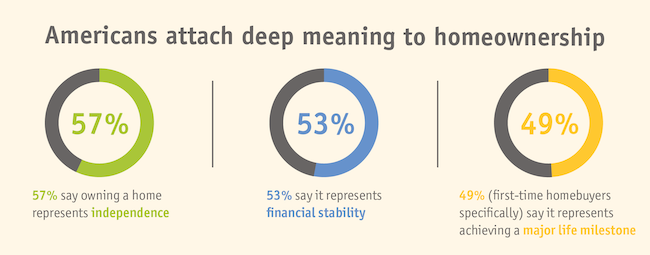
The desire and positive attitudes are not enough, however. Perceived attainability is lacking with 62% of Americans who don’t currently own a home believing homeownership to be out of reach for them today. A similar number of first-time homebuyers (57%) feel the same.
Among first-time homebuyers, the top financial barrier causing delays and reconsiderations is high home prices, with 39% citing this as their primary deterrent. More than half of Americans (51%), 73% of prospective homebuyers and 81% of first-time homebuyers say the rising interest rates have impacted their decision to buy a home.
Almost a third of Americans (32%) and 34% of prospective buyers say they would feel more prepared to buy a home is they had a better understanding of down payment requirements. Thirty percent of Americans, and 42% of prospective homebuyers, say understanding how their credit score impacts mortgage eligibility would make them feel more prepared to purchase a home and similar proportions (31% of Americans, 39% of prospective homebuyers) say the same of knowing the steps they can take to improve their credit score.
This survey was conducted online by The Harris Poll on behalf of FICO from June 4-8, 2026, among 3,047 U.S. adults ages 18 and older, among whom 449 plan to buy a home in the next 12 months, of which 175 are first-time homebuyers.