

Financial advisors must evolve for the next generation of inheritors
Editor’s note: Melissa Schweizer is VP of strategy and go to market at The Harris Poll.
As financial institutions brace for a seismic shift – an estimated $124 trillion transferring from Baby Boomers and the Silent Generation to Gen X and Millennials over the next 25 years – financial institutions must adapt their approach to serve an emergent cohort of clients with distinct values, priorities and expectations.
This intergenerational reallocation of assets – “The Great Wealth Transfer” – is far more than a matter of financial mechanics. It’s a cultural handoff, one that financial providers must manage not only with accuracy, but with emotional intelligence and deep alignment to evolving client values.
Key takeaways from the report (The Harris Poll)
- Shifting financial priorities
- Both older and younger generations value financial returns as their top investment goal – 54% for older, 62% for younger adults. Yet their secondary motivations diverge. Older Americans heavily emphasize diversification (43%) and minimizing risk (42%), whereas younger counterparts place a stronger premium on impact investing (28%) and ESG (13%).
- Wealth’s purpose is evolving
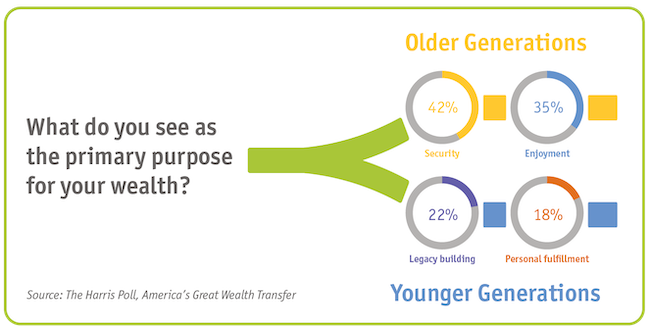
- Older generations see wealth primarily as a path to security (42%) and enjoyment (35%). Younger generations, while still valuing security, are significantly more motivated by legacy building (22%) and personal fulfillment (18%).
- Confidence vs. competence
- Sixty-four percent of older earners believe their heirs are capable of managing an inheritance responsibly. Only 25% want a say in how it’s handled. Even more telling: 83% of younger individuals say they are confident in their own ability to manage inherited assets.
- Complex emotions at play
- While inheritors largely expect to feel grateful (68%), they also anticipate experiencing hope (54%), joy (43%), relief (28%), alongside pressure (20%), anxiety (18%) and guilt (15%). Notably, older generations drastically underestimate these negative feelings.
- Brand loyalty is not a given
- Although 90%+ satisfaction levels exist with current providers among both age groups, 43% of younger beneficiaries still plan to switch asset managers after inheriting. Reasons cite misalignment on investment philosophy (38%), values mismatch (33%) and lack of trust or personal connection.
- Value of relationships amid digital demands
- Younger generations want more frequent contact – 64% meet several times a month or more with advisors, compared to just 7% of older clients. And while both groups trust human advisors over algorithms (66%–89%), younger clients are also keen on digital tools and 24/7 access.
Why wealth transfer should matter to financial advisors
Reimagine your target audience
Financial advisors must broaden their perspective on who constitutes "the client." The demographic is shifting beyond Baby Boomers to include younger inheritors who possess a confident and intentional approach to managing their wealth. These younger clients are focused not only on financial security and returns but also on defining their legacy and aligning their investments with their personal values.
To effectively serve this evolving client base, financial advisors should adjust their services and communications to emphasize how financial decisions can reflect personal values and contribute to legacy building, alongside traditional financial goals.
Prioritize emotional resonance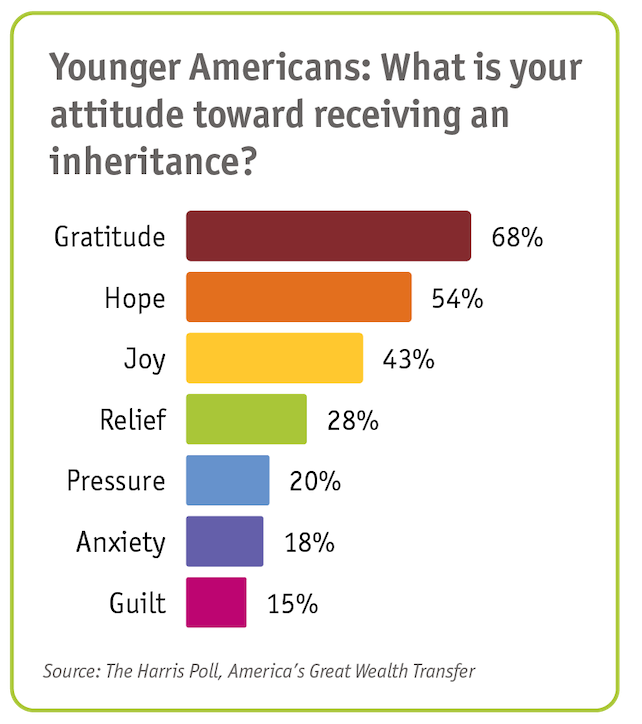
The emotional complexity of inheritance – joy mingled with guilt, anxiety, pressure – requires a sensitive approach from financial advisors. Recognizing these varied emotions, advisors should extend their role beyond traditional financial planning to act as empathetic partners. By integrating services such as education support, legacy planning and intergenerational communication tools, financial advisors can better meet the holistic needs of their clients, ensuring they address not only financial goals but also the emotional well-being tied to familial wealth.
Make trust and value alignment the core offer
With 43% of inheritors planning to switch providers, retaining that seat at the table is urgent for financial advisors. Trust isn’t automatic, even with high satisfaction rates among clients. Building a relationship or emotional connection with the younger generations before the inheritance is handed over is a critical step in ensuring continuity and trust.
For financial advisors, it is crucial to emphasize ethical integrity, highlight historical performance and ensure services are personalized, particularly in integrating clients' values into their financial planning. Positioning their practice around impact investing and client-centric services presents an opportunity to align closely with client expectations and values, thereby enhancing retention.
Serve human connection, backed by frictionless digital access
Younger clients crave collaboration, human expertise and responsive service – but they also expect convenience. Financial institutions should emphasize the seamless blend: tools that provide real-time access, alongside real advisors who are reachable and proactive, balancing relational depth with digital agility.
Educate while you sell
Younger heirs want literacy and confidence in managing inherited wealth. Financial institutions should position themselves as both a financial and educational resource – offering workshops, digital learning modules, intergenerational dialogues and next-gen advisory content. This positions the firm as a steward of both capital and knowledge.
The coming wave of wealth transfer isn’t merely a transfer of assets – it’s a transfer of values, expectations and brand loyalty. Consequently, financial advisors need to abandon legacy playbooks and adopt fresh, adaptive strategies to effectively connect with and serve this new generation.
This proactive approach to wealth management reinforces the advisor’s pivotal role in helping clients navigate both financial and value-driven aspirations.
Competition is fierce at every turn
The rise of online platforms, fintech innovations and resilient traditional financial players creates a crowded marketplace. Young investors are increasingly savvy, shopping around for providers that not only meet criteria for performance and trust but also align with personal and generational dynamics. Brands that understand and strategically position themselves in this competitive environment will be more likely to capture and maintain these forthcoming substantial assets.
Understanding a new generation of inheritors
As the great wealth transfer progresses, it’s crucial for financial advisors to evolve in response to the unique demands of a new generation of inheritors. These individuals are searching not only for financial expertise but also for value alignment, emotional understanding, and digital capabilities in their advisors. By redefining their target audiences, emphasizing emotional connections and incorporating digital tools along with personalized service, financial advisors can foster deep, lasting relationships that go beyond simple asset management. Adapting in this manner will be key for advisors aiming to thrive in a competitive landscape, ensuring client retention and crafting a legacy of thoughtful wealth management.